
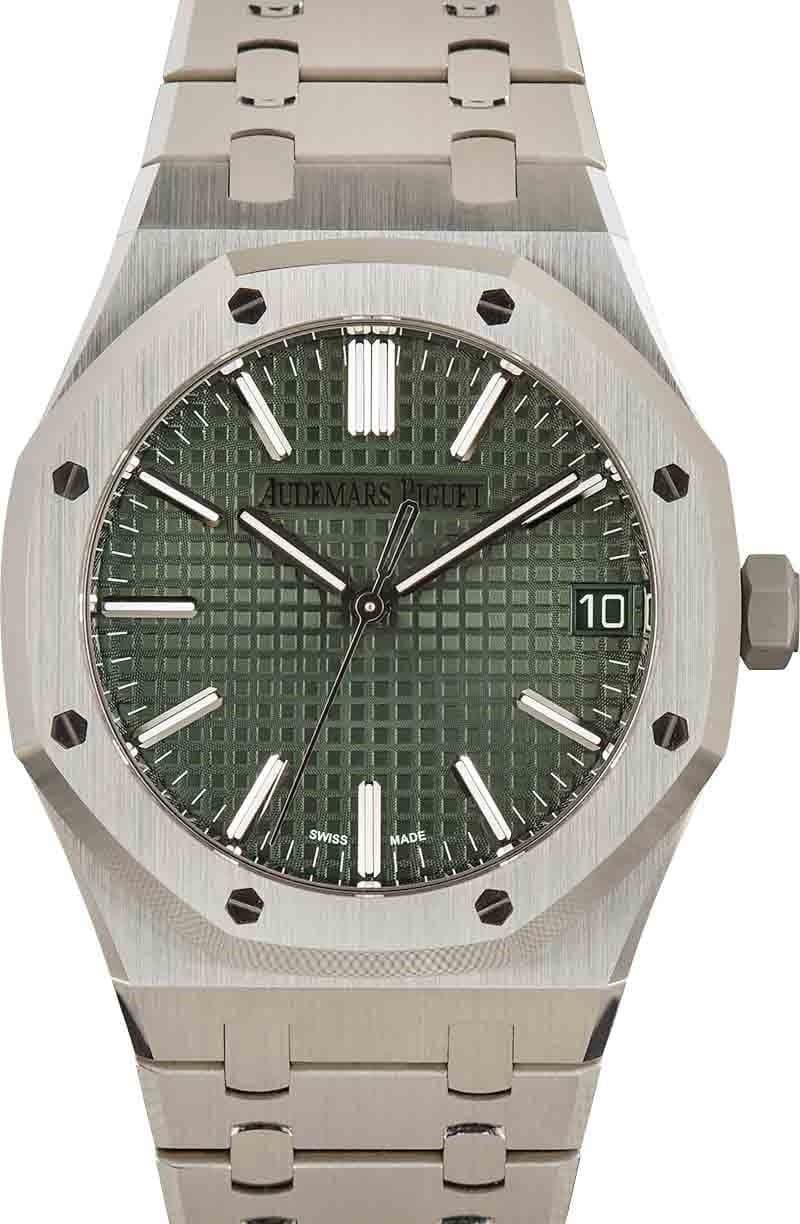
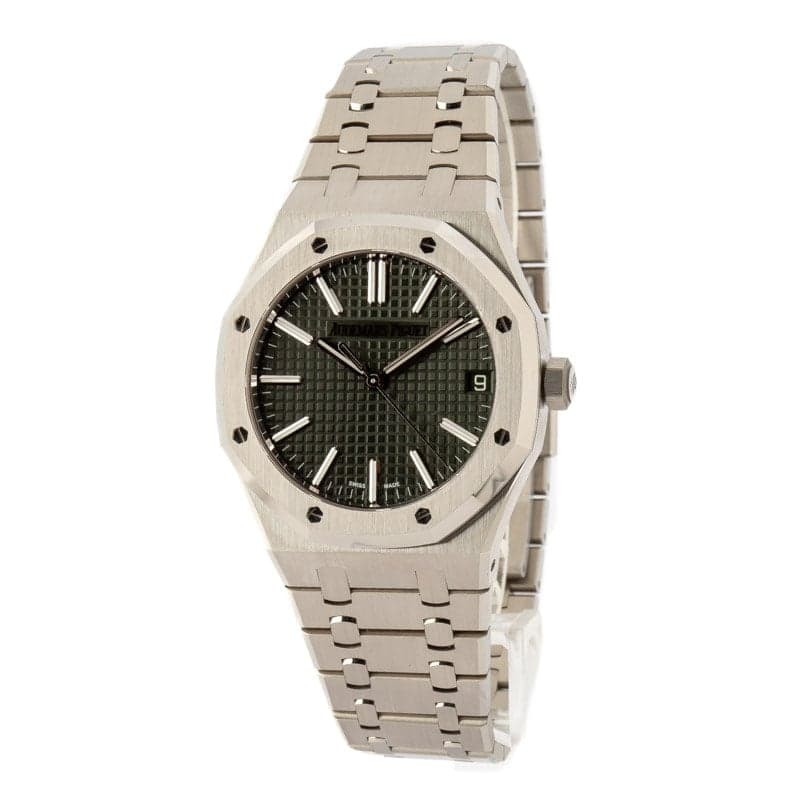
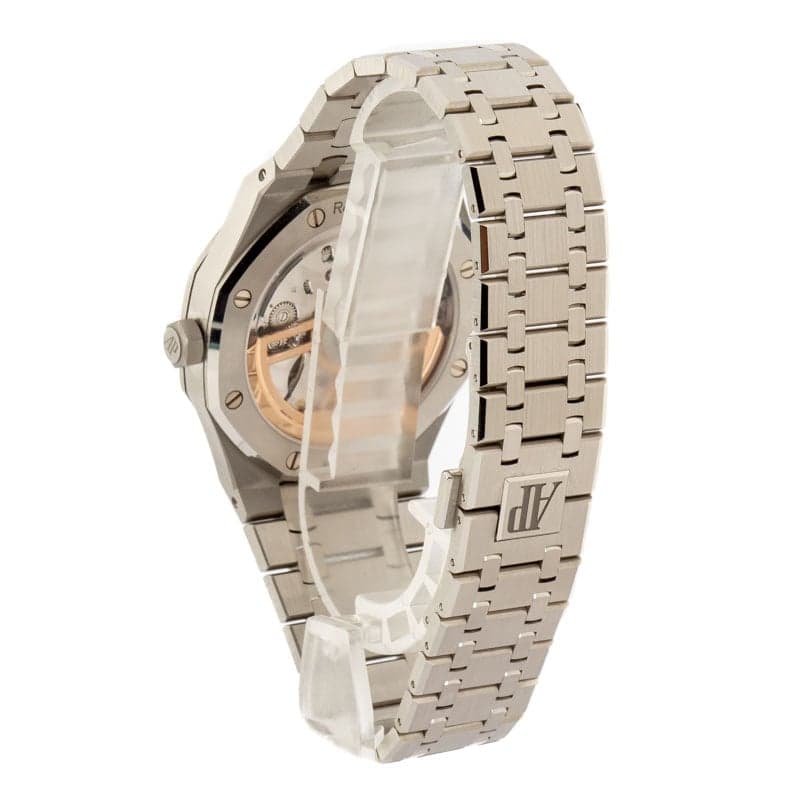
Audemars Piguet Royal Oak Selfwinding 41mm 15510ST
An integrated stainless-steel icon with a green Grande Tapisserie dial, octagonal bezel, and in-house calibre 4302.
$61,995

Introduced in 1972, the Royal Oak joined an octagonal bezel, exposed screws, integrated bracelet, and hand-finished surfaces in a radical luxury sports watch. Current and discontinued references range from compact selfwinding models to Jumbo, chronograph, openworked, and calendar executions.
An integrated stainless-steel icon with a green Grande Tapisserie dial, octagonal bezel, and in-house calibre 4302.
Model History & Buyer Guide
The original reference 5402 combined a thin automatic movement, octagonal bezel, visible screws, Tapisserie dial, and integrated steel bracelet. Its alternating satin and polished surfaces made hand finishing part of the design rather than decoration.
Later Royal Oaks span 33 to 41 mm and include quartz, Selfwinding, Jumbo Extra-Thin, Chronograph, perpetual calendar, and openworked references. Diameter alone is not enough: thickness and bracelet taper materially change wear.
The 41 mm 15510ST is the current Selfwinding benchmark, succeeding 15500ST and 15400ST. The 16202 continues the 39 mm Jumbo lineage; chronographs such as 26331 and 26240 use distinct movement generations.
Factory refinishing can restore surfaces within limits, but aggressive prior polishing rounds bezel edges and bracelet facets. Dial type, bracelet link count, and AP service records should accompany any price comparison.
Indicative secondary-market ranges in US dollars, researched from current market estimates and live dealer listings and updated August 2026. These are not fixed valuations: condition, originality, production year, service history, and completeness can move an individual watch outside the range.
| Reference | Configuration | Typical Pre-Owned Price | Market Note |
|---|---|---|---|
| 15510ST | Current 41 mm Selfwinding steel | $41,000 — $49,000 | Dial color creates meaningful variation |
| 15400ST | Discontinued 41 mm Selfwinding | $31,000 — $38,000 | Condition and dial drive the range |
| 16202ST | 39 mm Jumbo Extra-Thin | $75,000 — $100,000 | Low supply and dial matter |
| 26331ST | 41 mm Royal Oak Chronograph | $39,000 — $47,000 | Bracelet and service condition are important |
The Royal Oak’s visible geometry makes case and bracelet condition as important as the movement reference.
| Feature | Function | Why It Matters |
|---|---|---|
| Octagonal bezel | Frames the crystal with eight aligned screws | Sharp bevels are a primary condition indicator |
| Tapisserie dial | Creates a patterned grid | Pattern scale and color are generation-specific |
| Integrated bracelet | Uses graduated links with alternating finishes | Stretch and missing links can be expensive to correct |
Use the exact reference—not the family name alone—to verify the following points before purchase.
| Check | What to Verify | Why It Matters |
|---|---|---|
| Surface geometry | Bezel edges, screw slots, brushing, and polished bevels | Poor refinishing changes the design’s architecture |
| Bracelet | Link count, stretch, clasp, and reference | Proper fit and replacement links carry substantial cost |
| Movement generation | Reference, calibre, functions, and AP service history | Similar-looking 41 mm watches can have different movements |
About Royal Oak
The Offshore is a separate, larger and more overtly sporty family. It generally uses bulkier cases, rubber elements or straps, and chronograph or Diver formats.
It refers to the thin 39 mm lineage descending from the original 5402, not to a larger-than-normal case.
Factory refinishing may improve surfaces, but removed metal cannot be replaced indefinitely. Severe rounding remains a condition and value issue.
NYC Diamond District
Our specialists can compare references, movements, condition, service history, and set completeness. Contact Atlas Luxury for current Royal Oak availability or help sourcing a particular configuration.