Key Takeaways:
- Price gap: A massive ~$7,000–$9,000 difference (considering gray market prices for Rolex)
- Availability: Tudor is available immediately off-the-shelf; Rolex requires 18–36 month waitlists or secondary market premiums
- Main material difference: Rolex uses 904L steel and Cerachrom ceramic bezels; Tudor uses 316L steel and aluminum bezels (vintage aesthetic)
- Movement parity: Both use in-house COSC-certified movements with 70-hour power reserves—technical performance is nearly identical
- Verdict: Tudor offers 90% of the quality for 35% of the price, but lacks Rolex’s investment value and instant social recognition
The Heritage Connection: Brothers, Not Rivals
Hans Wilsdorf’s Vision
Tudor is not a “knock-off” or a competitor trying to copy Rolex. It was created by Hans Wilsdorf himself—the founder of Rolex—in 1946 with a specific mission: to offer Rolex dependability at a lower price point for markets where a full Rolex was financially out of reach.
Wilsdorf’s strategy was elegant: use the same robust cases and waterproof technology as Rolex, but substitute less expensive movements (initially ETA-based) to dramatically reduce costs. The result was a watch that inherited Rolex’s engineering DNA without the luxury premium.
Shared DNA
Historically, Tudor and Rolex shared parts—cases, crowns, tubes, and even bracelets in some eras. Vintage Tudor Submariners from the 1960s–1980s used Rolex cases and were serviced at Rolex facilities. Today, they are distinct entities with separate factories, separate R&D teams, and separate supply chains—but ownership remains the same (Rolex Group).
The modern Tudor is no longer “Rolex on a budget.” It’s a legitimate manufacture with its own identity, movements (Kenissi-made), and design philosophy. The connection is heritage, not dependence.
The Price Reality in 2025
MSRP vs. Market Value
This is where the comparison gets brutal:
Tudor Black Bay (41mm steel):
- MSRP: ~$4,200 USD
- Market reality: Available at authorized dealers immediately, or pre-owned for ~$3,200–$3,800
Rolex Submariner Date (41mm steel, ref. 126610LN):
- MSRP: ~$10,250 USD
- Market reality: Impossible to buy at retail without 18–36 month wait or extensive purchase history; gray market price ~$13,000–$15,000
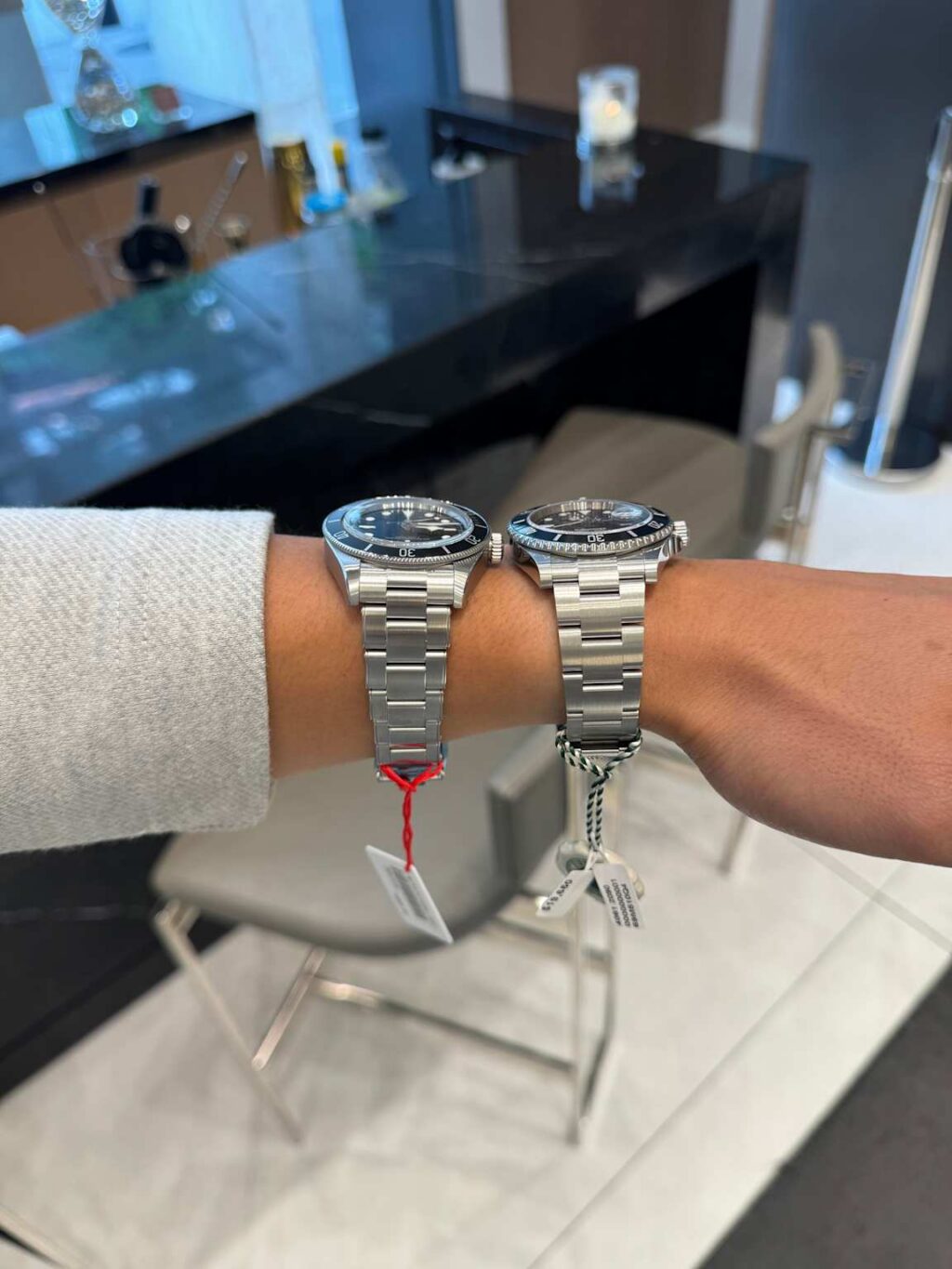
The “Real” Cost of Admission
If you want to walk out of a store with a Submariner today, you’re paying gray market premiums—typically $13,500–$15,000 for a black dial steel model. That creates a $9,000–$11,000 price gap versus buying a Tudor Black Bay at retail.
Even if you’re patient and willing to wait years for an authorized dealer allocation, the retail gap is still $6,050. That’s not pocket change—it’s another entire luxury watch, a down payment on a car, or a vacation.
Design Philosophy: Modern Perfection vs. Vintage Charm
The Bezel: Cerachrom vs. Aluminum
Rolex Submariner:
- Uses Cerachrom ceramic bezel—scratch-proof, fade-proof, color-stable
- Glossy, modern, futuristic aesthetic
- Platinum-filled numerals and markers (PVD-coated)
- Virtually indestructible—will look new 20 years from now
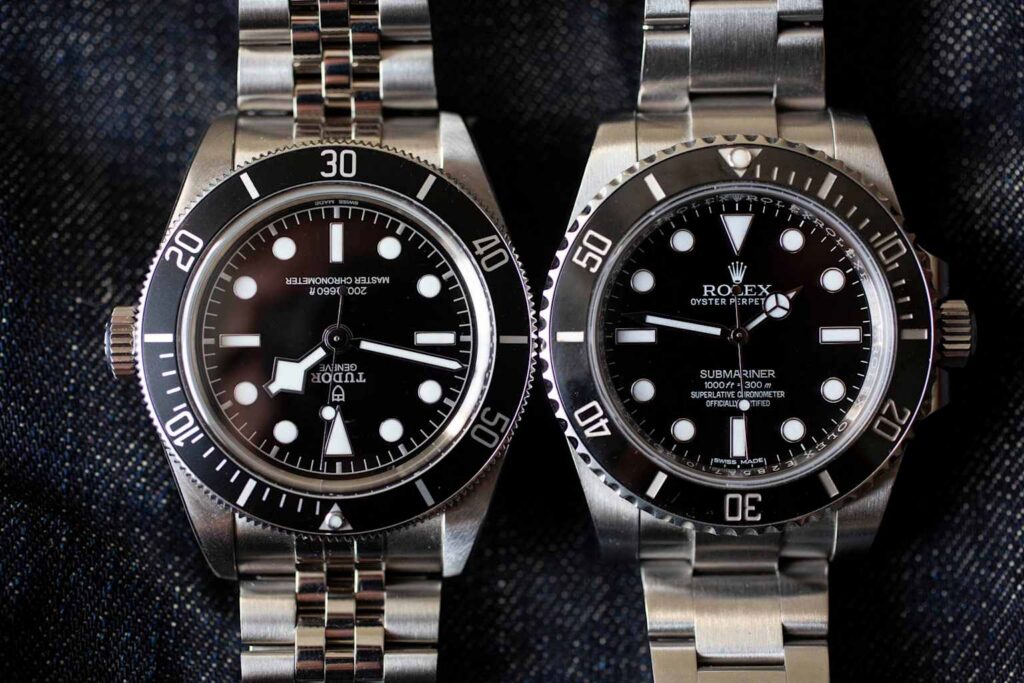
Tudor Black Bay:
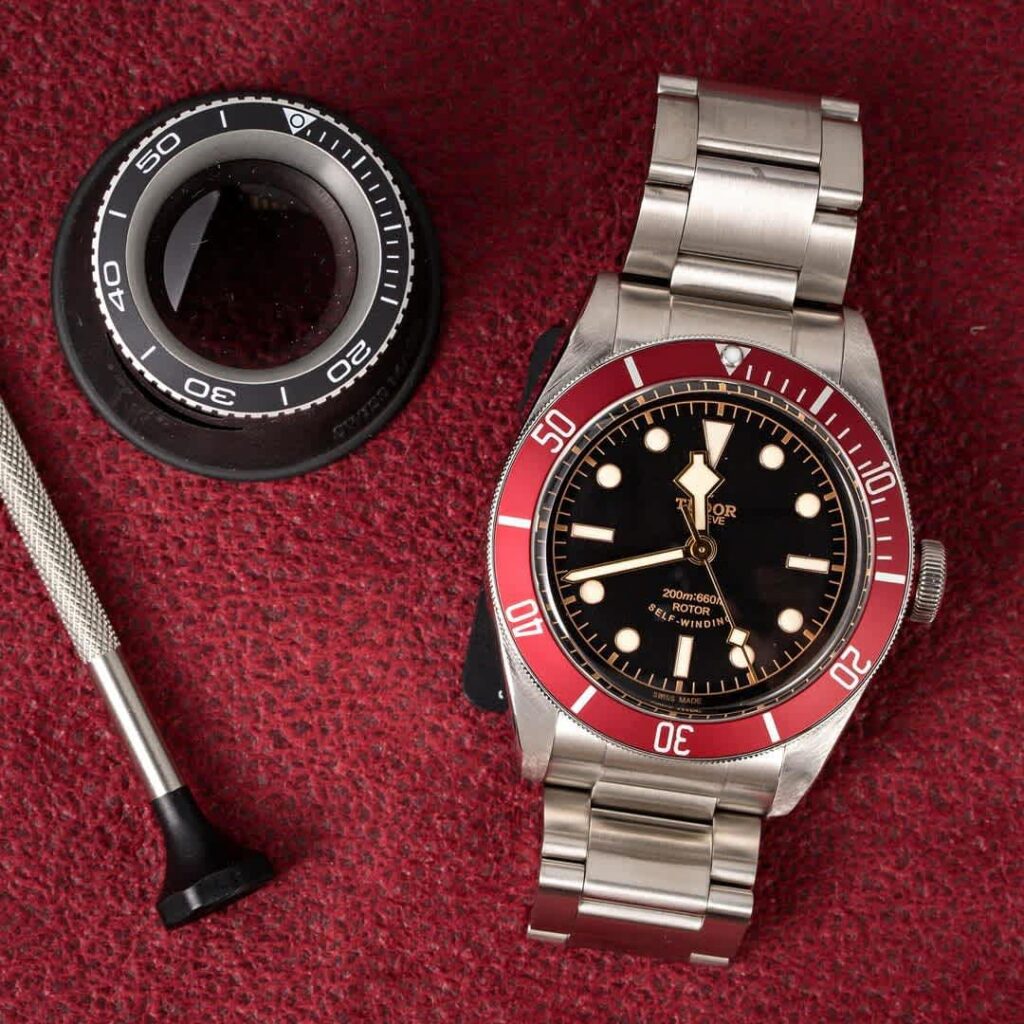
- Uses matte aluminum bezel insert—vintage aesthetic
- Fades over time, develops patina, scratches with use
- Warm, nostalgic look that evokes 1950s–1970s dive watches
- Part of the charm is the aging—collectors embrace the wear
This is the defining philosophical split. Rolex chose perfection and permanence. Tudor chose character and nostalgia. Neither is objectively better; it’s about what you value.
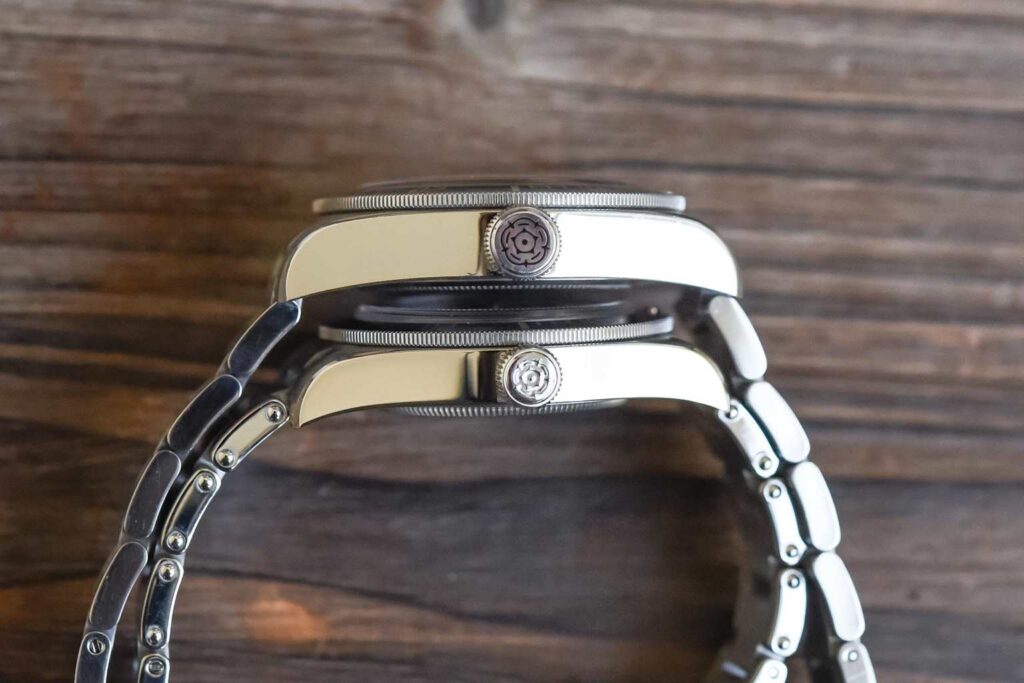
Case Profile: The “Slab” Complaint
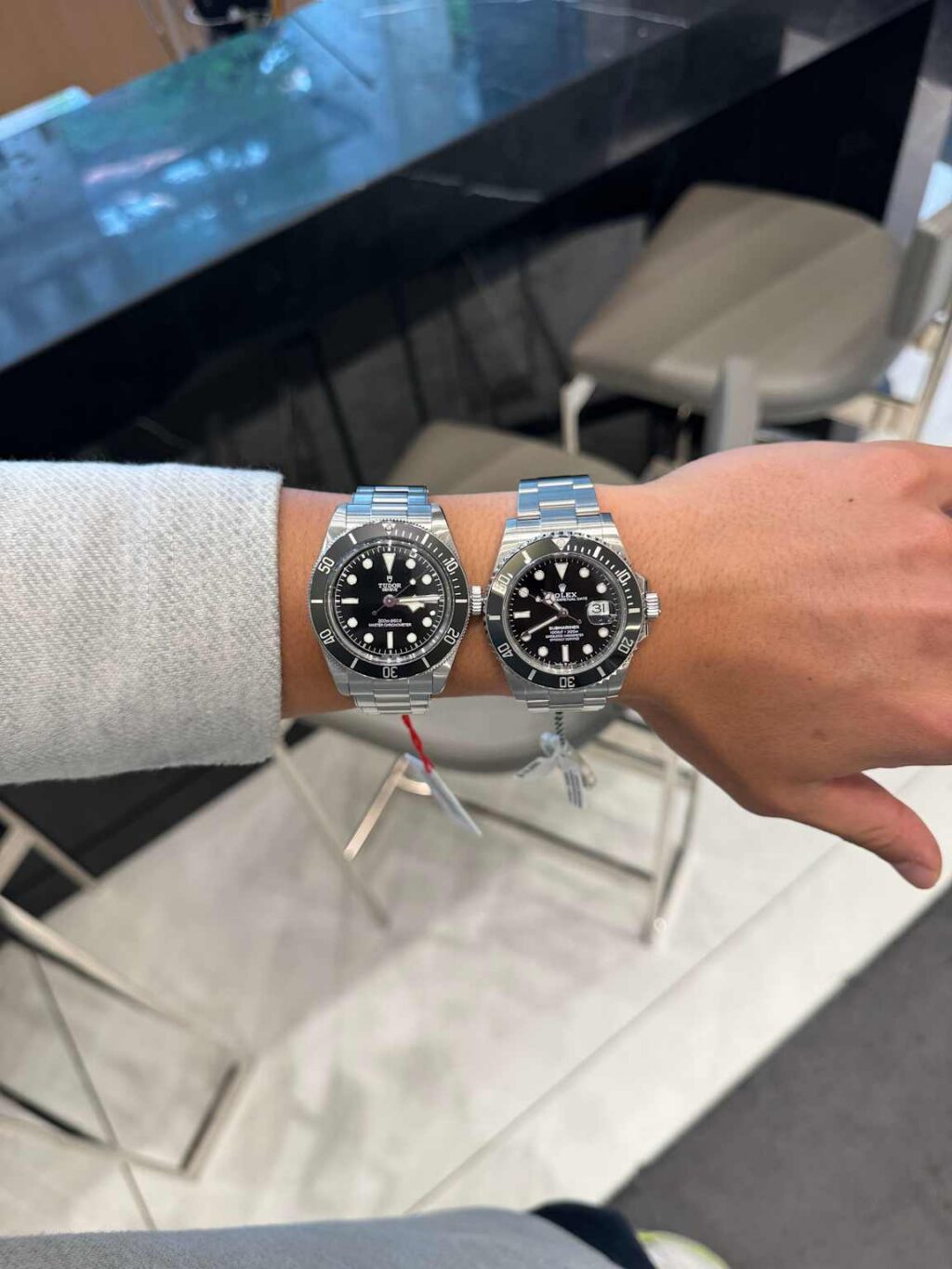
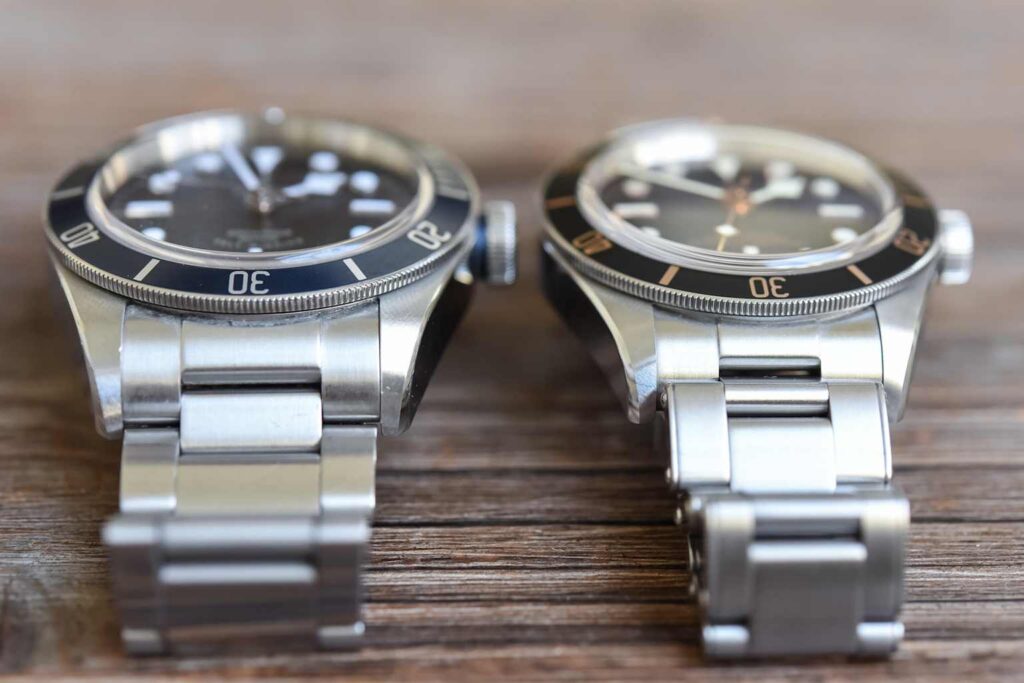
Tudor’s Achilles’ heel is case thickness. The Black Bay 41 measures approximately 14.6mm thick—noticeably taller than the Submariner’s 12.5mm. On the wrist, this extra 2mm creates a “slab-sided” appearance that some collectors dislike.
The Rolex Submariner hides its thickness beautifully through case shaping, bracelet taper, and crown guard design. It wears slimmer than its specs suggest. The Tudor feels more substantial—some love it (tool watch vibe), others find it bulky (especially under dress shirts).
Hands and Markers: Mercedes vs. Snowflake
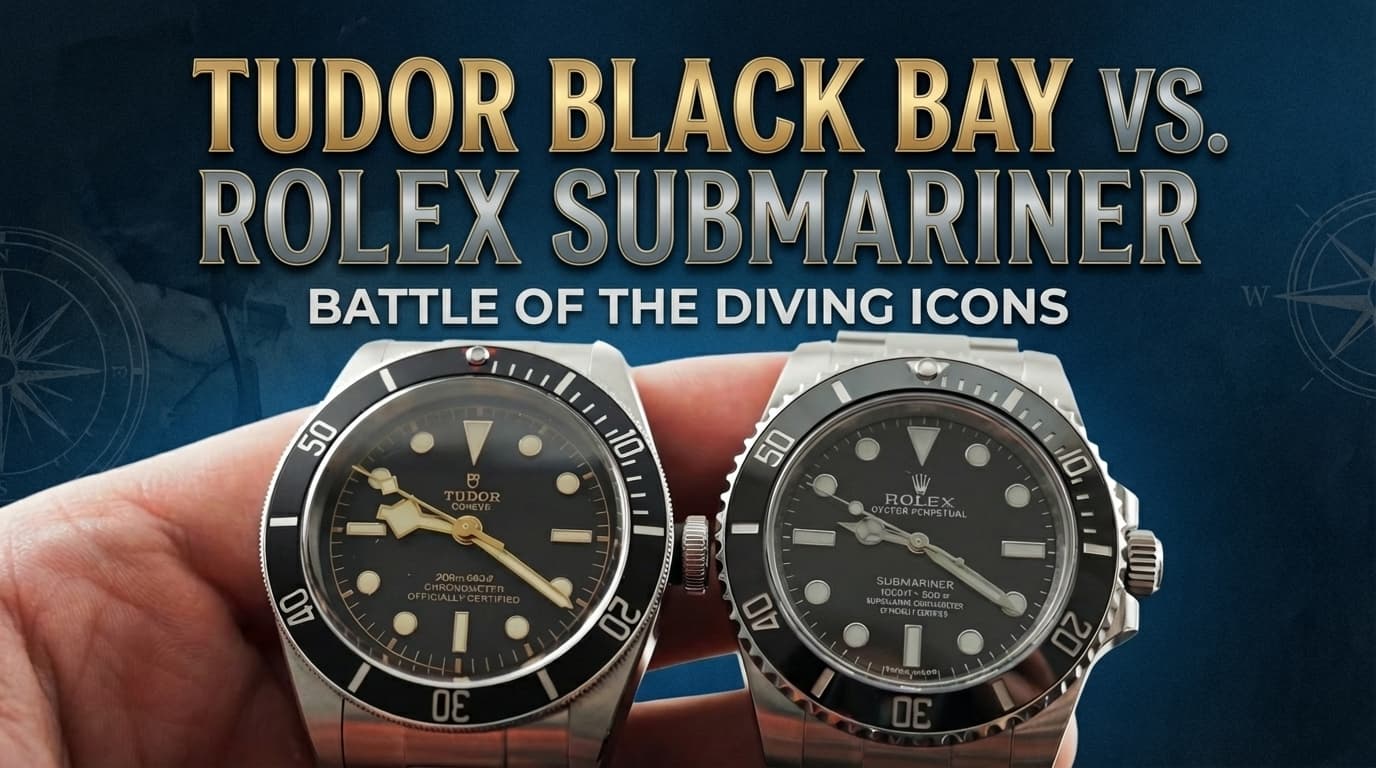
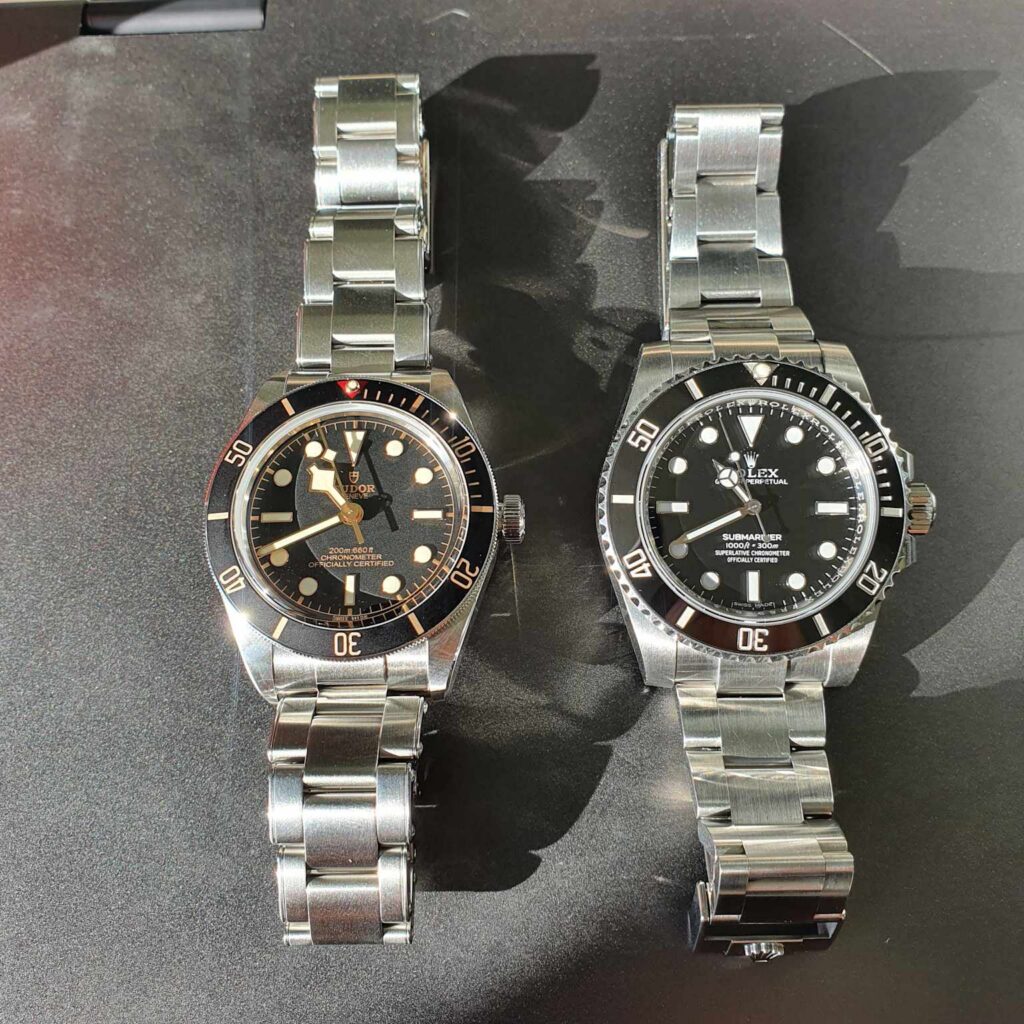
Rolex: Iconic Mercedes hour hand (three-pointed star) paired with stick minute hand—instantly recognizable silhouette
Tudor: Angular snowflake hour hand (diamond-tipped square) paired with pencil minute hand—vintage military aesthetic
The snowflake hand is polarizing. Enthusiasts love it as Tudor’s signature; detractors call it “blocky” or “clumsy.” The Mercedes hand is universally praised for elegance and legibility.

Technical Specifications: The Engine Room
Materials: 904L vs. 316L Steel
Rolex 904L Oystersteel:
- Harder to machine, requiring specialized tooling
- Higher corrosion resistance, especially in saltwater and acidic environments
- Unique whitish luster—slightly brighter, more “silvery” than standard steel
- Used in aerospace and chemical industries
Tudor 316L Stainless Steel:
- Industry standard for luxury watches (used by Omega, Breitling, IWC, etc.)
- Excellent corrosion resistance for 99.9% of use cases
- Easier to machine, reducing production costs
- Slightly warmer tone than 904L
In practical terms, the difference is negligible for 99% of wearers. Unless you’re diving in sulfuric acid, 316L is more than adequate. But 904L is objectively superior, and Rolex leverages this in marketing.
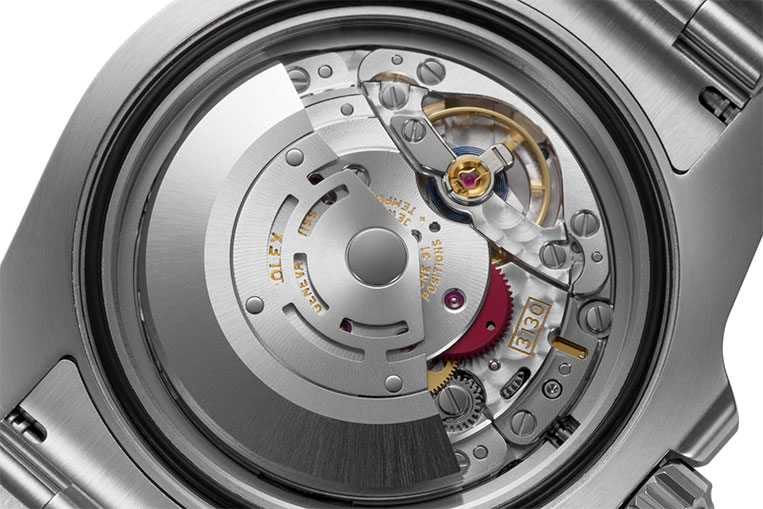
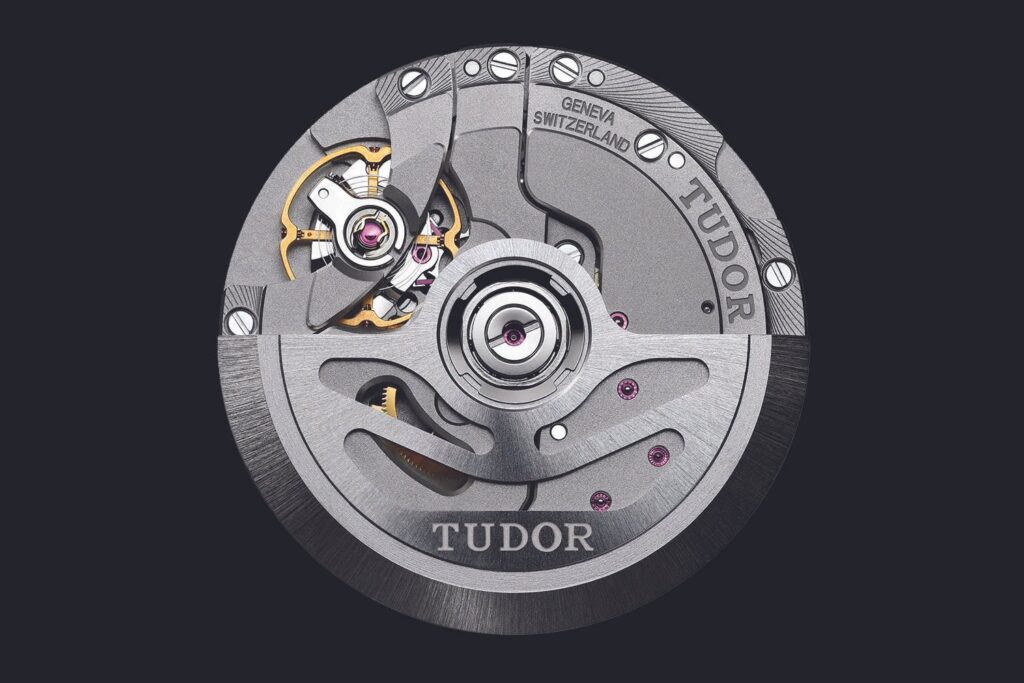
Movements: Caliber 3235 vs. MT5602
| Specification | Rolex Cal. 3235 | Tudor MT5602 |
|---|---|---|
| Manufacture | In-house (Rolex) | In-house (Kenissi, owned by Rolex Group) |
| Power Reserve | 70 hours | 70 hours |
| Frequency | 28,800 vph | 28,800 vph |
| COSC Certified | Yes | Yes |
| Accuracy | -2/+2 sec/day (Superlative Chronometer) | -4/+6 sec/day (COSC standard) |
| Hairspring | Parachrom (blue, paramagnetic) | Silicon (paramagnetic) |
| Hacking | Yes | Yes |
The movements are functionally equivalent. Both hack, both have 70-hour reserves, both are COSC-certified. Rolex’s Superlative Chronometer standard is tighter (-2/+2 vs. -4/+6), but in daily wear, you won’t notice the difference.
The Bracelet & Clasp War
Rolex Glidelock:
- The gold standard of micro-adjustment
- Tool-free adjustment in 2mm increments (up to 20mm total)
- Smooth, precise, rock-solid lockup
- Adds significant cost to manufacturing
Tudor T-Fit:
- Tudor’s answer, introduced in 2021
- Tool-free adjustment in ~8mm total range via sliding clasp
- Less granular than Glidelock, but genuinely excellent
- Standard on newer Black Bay models (including BB54, BB Pro)
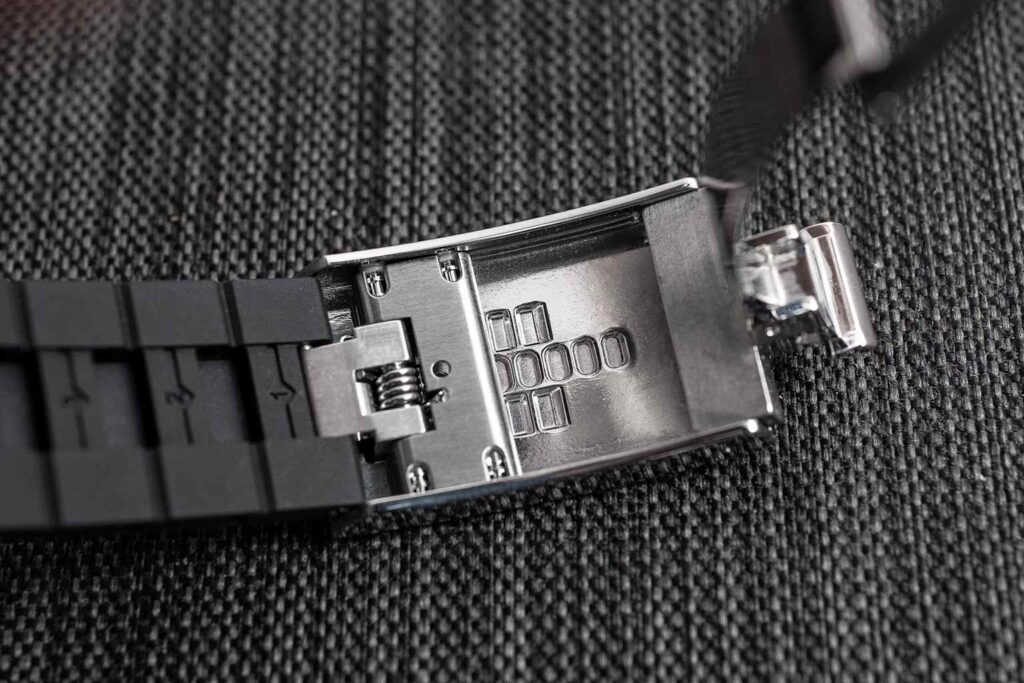
The T-Fit clasp is a game-changer for Tudor. Older Black Bay models (pre-2021) used basic flip-lock clasps with limited adjustment, which was a major complaint. The new T-Fit system brings Tudor within striking distance of Rolex’s convenience.
Social Signaling and Brand Prestige
The “Is That a Rolex?” Moment
Here’s the uncomfortable truth: wearing a Tudor requires explanation. Most people—even wealthy, educated people—don’t recognize Tudor. They might compliment your “nice watch,” but they won’t know what it is.
Wearing a Submariner requires zero explanation. It’s instantly recognized across continents, income brackets, and cultures. The crown logo is one of the most valuable brand symbols on Earth, rivaling Nike, Apple, and Mercedes-Benz.
If you care about instant status signaling, Rolex wins by default.
The “Poor Man’s Rolex” Stigma
For decades, Tudor carried the stigma of being the “poor man’s Rolex”—a consolation prize for those who couldn’t afford the real thing. Among serious collectors and enthusiasts, this stigma has died. Tudor is now respected as a legitimate manufacture with its own identity.
But among the general public, the stigma persists. Your banker, lawyer, or business partner might see your Tudor and think, “He wanted a Rolex but settled.” Fair or not, perception matters in luxury goods.
Where Tudor Wins: Stealth Wealth
Tudor is the smarter travel watch. In high-crime cities (Barcelona, Paris, parts of NYC, Latin America), wearing a Rolex makes you a target for “Rolex Rippers”—thieves who target luxury watches. A Tudor offers similar quality without painting a target on your wrist.
For “quiet luxury” enthusiasts who don’t want to advertise wealth, Tudor is perfect. It’s the watch equivalent of driving a Lexus instead of a Mercedes—equally capable, far less flashy.
Investment and Resale Value
The Depreciation Curve
Tudor Black Bay:
- Walks out of the authorized dealer at $4,200
- Immediately worth ~$3,200–$3,500 on the secondary market
- 20–25% depreciation the moment you leave the store
- Stabilizes after initial drop; vintage models can appreciate (but modern ones don’t)
Rolex Submariner:
- Official retail $10,250
- Secondary market $13,000–$15,000
- Immediate 25–45% appreciation if you can buy at retail
- Holds value even through recessions
If you view your watch as an investment, Rolex is the only rational choice. If you view it as a tool to enjoy, Tudor offers better value.
The Cost of Ownership
Service costs:
- Tudor service: ~$600–$900 for complete overhaul
- Rolex service: ~$800–$1,200 for complete overhaul
The difference is real but not dramatic. Both require service every 7–10 years under normal wear. Over a 30-year ownership period, the service cost difference is maybe $1,500–$2,000 total.
Comparison Table: Specs at a Glance
| Feature | Rolex Submariner | Tudor Black Bay 41 |
|---|---|---|
| Case Size | 41mm | 41mm |
| Thickness | 12.5mm | 14.6mm |
| Bezel Material | Ceramic (Cerachrom) | Aluminum (matte) |
| Steel Type | 904L Oystersteel | 316L Stainless |
| Movement | Cal. 3235 (in-house) | MT5602 (in-house) |
| Power Reserve | 70 hours | 70 hours |
| Water Resistance | 300m | 200m |
| Warranty | 5 years | 5 years |
| MSRP | $10,250 | $4,200 |
| Market Price | $13,000–$15,000 | $3,200–$4,000 |
Conclusion: Who Should Buy What?
Buy the Tudor Black Bay If:
- You love vintage aesthetics (aluminum bezel, riveted bracelet, snowflake hands)
- You want a tool watch you can beat up without guilt or financial loss
- You refuse to play authorized dealer waitlist games or pay gray market premiums
- You value under-the-radar luxury and don’t need everyone to recognize your watch
- You want 90% of Rolex quality for 35% of the price
Buy the Rolex Submariner If:
- You want the absolute icon and accept no substitutes
- You care about value retention and investment potential
- You prefer a slimmer, more modern profile (12.5mm vs. 14.6mm)
- You value instant social recognition and brand prestige
- You want ceramic bezel perfection that will look new forever
The $7,000 Verdict
Technically, the Rolex Submariner is 15–20% better: superior steel (904L), superior bezel (ceramic), superior finishing, tighter tolerances. But you’re paying 200–250% more for those incremental improvements plus the brand equity.
Is it justified? If you’re buying purely on engineering merit, no. The Tudor delivers 90% of the performance for 35% of the cost.
But if you factor in brand prestige, resale value, and social signaling, the Rolex becomes rational. You’re not just buying a watch—you’re buying liquidity, recognition, and status.
For most people, the Tudor is the smarter buy. For those who can afford both without thinking twice, the Rolex is worth every penny.
The honest answer: Buy the Tudor. Enjoy it. Save the $7,000 difference. Then, when you can truly afford a Submariner without financial strain, buy that too. You’ll appreciate both for different reasons.