Immediate Answer
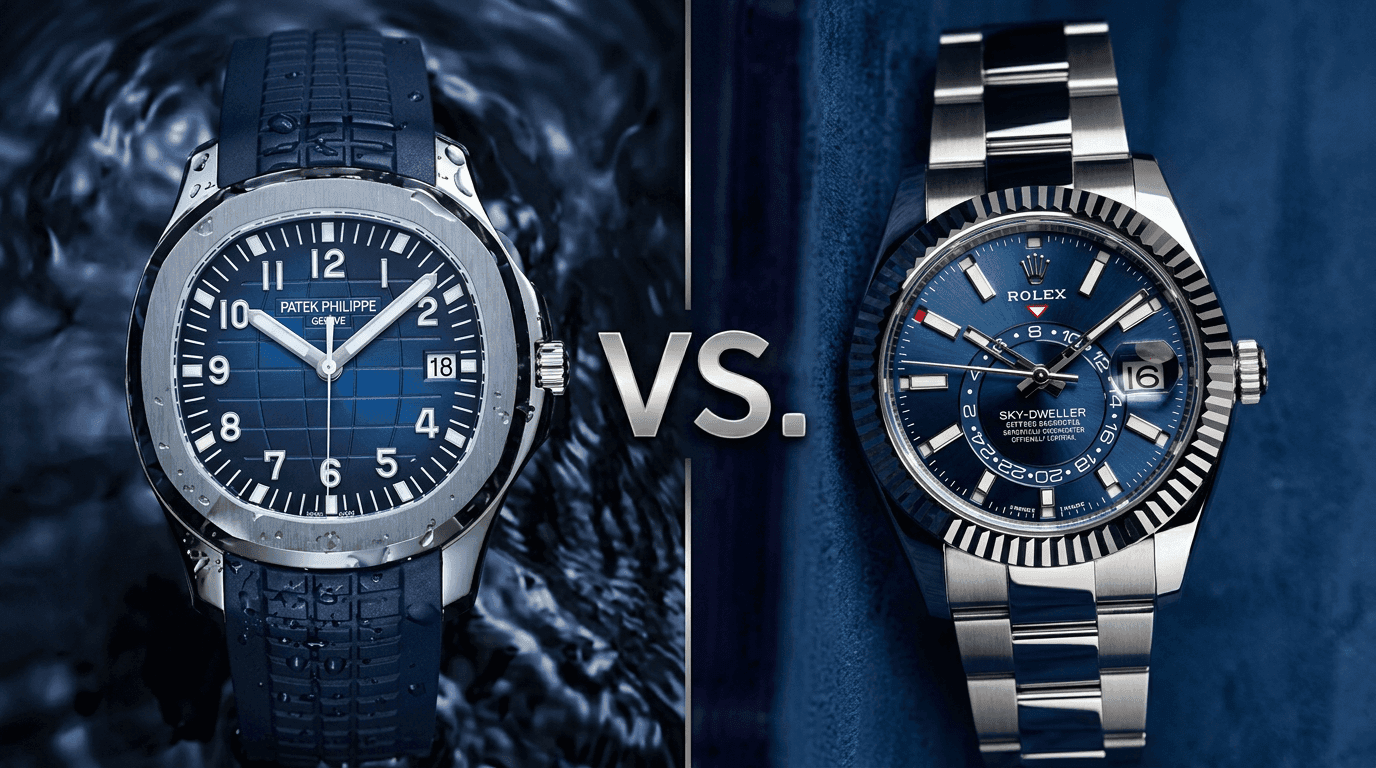
The Rolex Sky-Dweller trades faster in the secondary market and carries lower authentication risk due to higher production volume and established dealer networks across the US. The Patek Philippe Aquanaut commands stronger price retention relative to retail—particularly newer references like the 5164G—but faces tighter buyer pools and longer holding periods. Your choice depends on whether you prioritize rapid liquidity and mechanical complexity (Sky-Dweller) or prestige, compact size, and steady appreciation potential (Aquanaut). The next step is determining your intended holding period, condition requirements, and whether you’re sourcing for resale or personal wear.
Quick Decision Snapshot
Use this framework to compare the two models at a glance:
- Sky-Dweller: Annual calendar complication, dual time zone, 42mm case, available in steel and precious metals; faster secondary-market movement, wider dealer acceptance
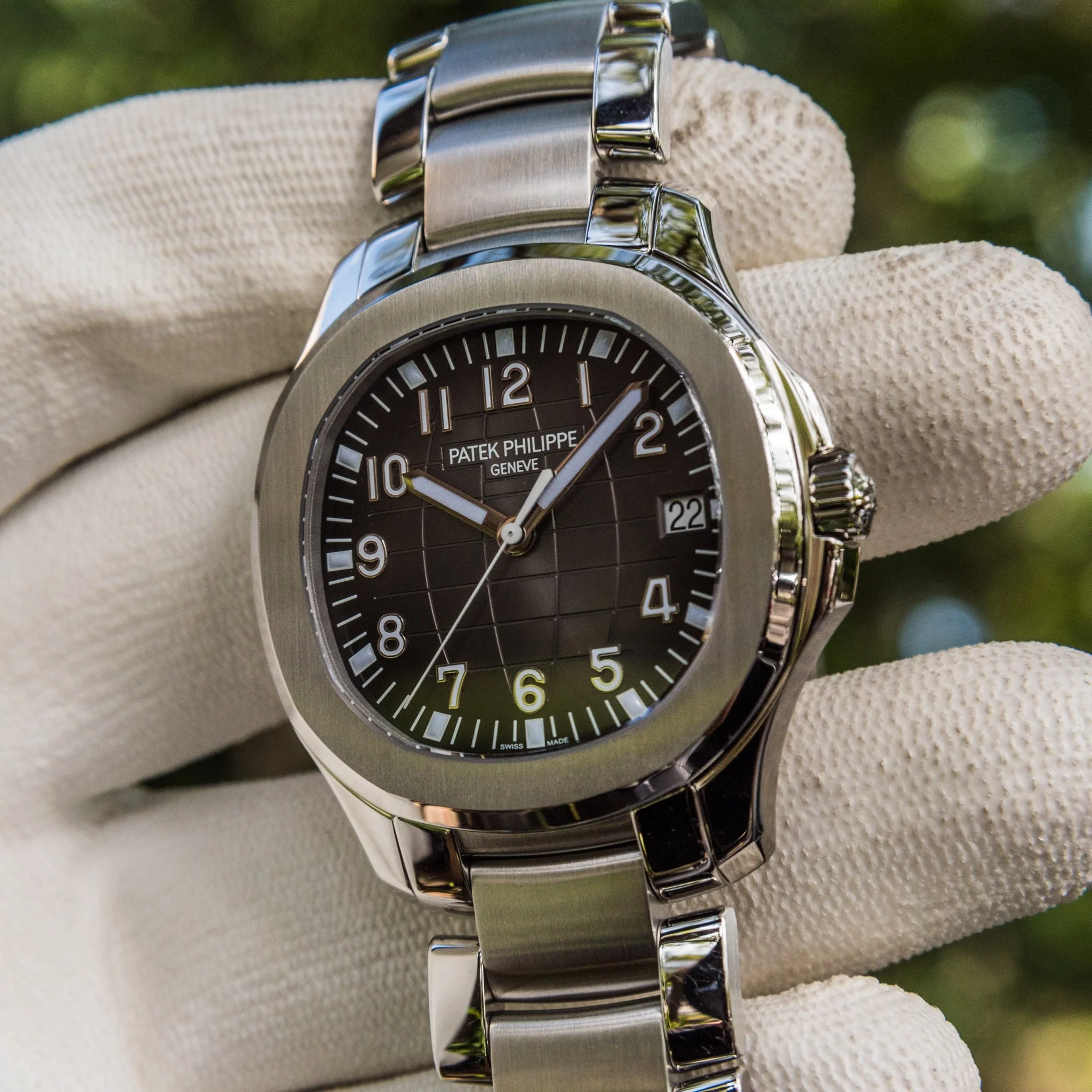
- Aquanaut: Octagonal case, tropical strap, 42.2mm (most versions), sports-casual aesthetic; slower to move but retains value closer to retail in strong demand periods
- Liquidity edge: Sky-Dweller wins on transaction speed; Aquanaut holds price better if you can wait 6–12 months for the right buyer
- Authentication complexity: Both require expert verification, but Aquanaut’s lower production numbers mean fewer reference examples for comparison
- US buyer advantage: Sky-Dweller pricing remains competitive across major markets; Aquanaut prices vary regionally, with New York and Los Angeles showing stronger demand
Educational market guidance only—not financial advice. Past secondary-market performance does not predict future values or timelines.
What Actually Drives Value and Demand
Condition, completeness, and market timing matter far more than model selection alone. A Sky-Dweller in good condition with full box and papers will sell faster than an Aquanaut in unknown service history, regardless of model prestige. Demand cycles for steel sports watches in the US run 8–18 months, meaning a watch purchased at peak demand may take significantly longer to move six months later.
Reality check: The Aquanaut 5164G (blue, 2024 release) trades near $130,000 against a $63,040 MSRP, but this premium depends entirely on current waiting-list scarcity at authorized dealers. Once supply stabilizes, secondary premiums compress. The Sky-Dweller typically trades at 50–80% of retail on the secondary market, making it less volatile but also less appealing to price-appreciation buyers.
Example: A steel Aquanaut 5167 purchased in January 2024 at $85,000 (gray-market entry) may have moved to $92,000 by Q3 2025 if the buyer needed liquidity quickly. A comparable Sky-Dweller purchased at $50,000 in the same period would have depreciated to $42,000–$48,000 if sold within six months, but found a buyer within 30–45 days. Different goals, different timelines.
Category-Specific Evaluation Framework
Both watches require the same authentication protocol, but the focus points differ. Use this ordered workflow when evaluating either model:
- Verify movement serial alignment: Cross-check the movement serial against the case serial using official Rolex or Patek Philippe archives. Mismatches are rare but indicate either service history issues or counterfeits.
- Inspect case finishing and weight: Steel density and hand-finished beveling vary by year. Aquanauts show tropical strap aging that should match case age (typically 3–5 years visible patina). Sky-Dwellers use Oysterflex bracelets that resist aging but should show proportional wear to the case.
- Dial and hand examination: Both brands use applied indices on steel models. Examine printing sharpness, lume consistency, and hand proportions under 10x magnification. Counterfeits typically show fuzzy printing or inconsistent hand colors.
- Complication testing: Sky-Dwellers require annual calendar function verification (month advance at midnight, no jump on most days). Aquanauts typically feature date-only or calendar complications—test rapid-set tolerance and advancement smoothness.
- Service records and warranty cards: Original Patek warranty cards are often missing; Sky-Dwellers typically retain cards. Missing papers reduce value 15–25% but do not indicate inauthenticity if other markers align.
Pricing Mechanics and Trade-Offs
| Metric | Rolex Sky-Dweller | Patek Philippe Aquanaut |
|---|---|---|
| Current MSRP (Steel) | ~$52,000–$58,000 | ~$24,000–$63,000 (ref-dependent) |
| Typical Secondary Price (6–12 mo. old) | $42,000–$50,000 | $70,000–$130,000 (5164G+), $50,000–$75,000 (5167) |
| Time to Move (avg.) | 30–60 days | 60–120 days |
| Dealer Network Density (US) | Broad (200+ major dealers) | Moderate (60–100 specialists) |
| Estimated Holding Cost (inspection, insurance, marketing) | $1,500–$3,000 | $2,000–$4,500 |
Trading logic: A Sky-Dweller purchased at gray-market entry ($48,000) carries immediate $3,000–$8,000 loss if sold within 90 days—but you recover that cost through faster transaction closure and lower carrying expense. An Aquanaut purchased at $80,000 may trade at $88,000–$95,000 if held 8–14 months, but requires patient buyer cultivation and higher marketing spend.
Example: You source a steel Sky-Dweller at $47,000 and appraise it at $52,000 asking price. If it moves in 45 days, your net cost is $52,000 − $47,000 − $1,200 (inspection, insurance, photography) = $3,800 gross profit. An Aquanaut sourced at $75,000 and listed at $92,000 moves in 110 days: $92,000 − $75,000 − $2,800 = $14,200 gross profit, but requires $2,000 additional holding cost (insurance, rent allocation) = $12,200 net. Both paths are viable depending on your capital velocity and inventory capacity.

Risk Control and Authentication Workflow
Protect yourself and your buyers by implementing a verification checklist before purchase and listing:
- Request complete service history or original warranty card. Missing service history is acceptable for Aquanauts (common due to Patek’s service protocols) but reduces offer by 10–15%. Sky-Dwellers almost always retain service records.
- Use a certified appraiser or watchmaker for movement verification. Cost is $150–$400 but prevents $10,000+ loss from authentication failure.
- Photograph the watch under UV light, close-up on dial, and case-back with serial visible. Digital evidence protects you in resale disputes.
- Verify current market comps weekly using major reseller platforms. Prices shift 2–5% month-to-month based on demand cycles and new model releases.
- Source from known gray-market dealers or private sellers with traceable purchase history. Avoid one-off marketplace sellers without return policies.
- Test the annual calendar complication (Sky-Dweller) by setting it forward 30 days. The month wheel should not advance on days 2–30, advancing only on day 31+. Counterfeits often fail this test.
Action Plan by Intent (Sell / Buy / Source / Appraise)
| Scenario | Best Choice | Why | Timeline |
|---|---|---|---|
| I own one and need cash in 60 days | Sky-Dweller | Faster secondary-market movement, broader dealer interest, lower authentication friction | 4–8 weeks |
| I want to hold and let appreciation work | Aquanaut (new references) | Stronger price retention relative to retail, prestige appeal, limited production | 12–18 months |
| I’m building a rotation for wear | Sky-Dweller | Technical complexity and dual time zone justify ownership; easier to sell if plans change | Ownership-duration neutral |
| I’m sourcing inventory as a dealer | Either (depends on capital) | Sky-Dweller if you have 3–5 units rotating; Aquanaut if you specialize in prestige/rarity | Ongoing |
Sell-Intent Workflow (Fastest Path)
If you own either watch and need to convert it to liquidity, follow this sequence:
- Gather documentation immediately. Locate original box, warranty card, service records, and original strap/bracelet. If missing, note condition and timeline in your listing.
- Have a certified appraiser inspect the movement and case. Cost: $200–$300. Provide this report to potential buyers—it accelerates serious offers.
- Price competitively using last 30 days of completed sales data. Avoid leading with asking price; let recent comps guide your floor. Price 5–10% above comps to account for negotiation.
- List on multiple channels simultaneously: major resale platforms, regional luxury consignment shops, and your personal network. The Sky-Dweller typically reaches a buyer within 45 days through any channel; the Aquanaut may need 60–90 days on the primary platform but move faster through specialist networks.
- Respond within 4 hours to authentication questions and viewing requests. Delay kills momentum, especially for Sky-Dwellers.
- Expect 10–20% price negotiation. Budget this into your floor pricing.
Reality check: You cannot force a buyer timeline. A pristine Aquanaut may sit for 6 months if market sentiment shifts toward sports watches, while a Sky-Dweller in fair condition may move in 3 weeks. Accept this variance and price accordingly—if you need guaranteed speed, accept a 8–12% discount to move it within 30 days.
FAQ
Q: How do I spot a counterfeit Sky-Dweller?
A: Examine the annual calendar complication—counterfeits typically fail to advance correctly on day boundaries. Verify the Ring Command bezel rotates smoothly with clear tactile clicks (8 per rotation). Check movement serial against Rolex’s service archives online. If you cannot verify these three markers, have a watchmaker inspect before purchase.
Q: Is the Aquanaut a better long-term hold than the Sky-Dweller?
A: Not necessarily. Recent Aquanauts (5164G, 5165, 2023+) trade above retail due to scarcity, but supply normalization could compress premiums 20–30%. Sky-Dwellers depreciate faster initially but stabilize at 50–60% MSRP. If you hold 3+ years, both typically avoid significant loss, but timing your exit matters more than model choice.
Q: Can I buy a Sky-Dweller at gray-market prices and flip it quickly for profit?
A: Rarely. Gray-market Sky-Dwellers enter at 10–15% below authorized dealer MSRP; secondary buyers expect 5–10% discount from gray pricing. Your real opportunity is patient holding (12+ months) or sourcing at auction/estate below gray-market rates.
Q: What’s the difference between a tropical strap and regular Aquanaut strap?
A: Tropical straps are Patek’s proprietary composite material, prone to color fading and aging in sunlight over 3–5 years. This “vintage” look adds character but signals age. Buyers either love or heavily discount tropical aging. Always disclose this in listings.
Q: Do I need original papers to sell either watch?
A: No, but expect 15–25% price reduction without them. Many Aquanauts lack original warranty cards due to Patek’s service history; Sky-Dwellers almost always retain cards. Original box alone adds 5–10% value.
Q: How often should I service a Sky-Dweller or Aquanaut?
A: Rolex recommends every 10 years; Patek Philippe recommends every 3–5 years. Service costs $1,200–$2,500 per brand. If you’re selling, disclose if service is overdue—this reduces buyer confidence.
Q: Which watch is easier to authenticate on my own?
A: Sky-Dwellers are easier due to higher production volume and more documented references. Aquanauts, especially older references, require expert verification because fewer examples exist in private hands. If you’re unsure, pay for professional authentication—it’s worth the $200–$300 protection.
Q: Can I negotiate price when buying from a dealer?
A: Yes, typically 3–8% on pre-owned models, less on new or rare pieces. Authorized dealer prices are usually fixed. Gray-market dealers have more room to negotiate, especially if you’re buying multiple pieces.
Q: What’s the resale difference between steel and precious-metal versions?
A: Steel Sky-Dwellers and Aquanauts move faster and attract broader buyer pools. Gold and platinum versions command premiums (typically 20–40% more) but take 2–3x longer to sell. If liquidity is priority, choose steel.
Q: Should I wait for new model releases before buying used?
A: New releases typically reduce secondary prices for outgoing references by 5–15% within 6 months. If you’re buying used, post-release timing (wait 3–6 months after launch) often yields better pricing. Check Rolex and Patek Philippe release calendars before committing to purchase.