Immediate Answer Block
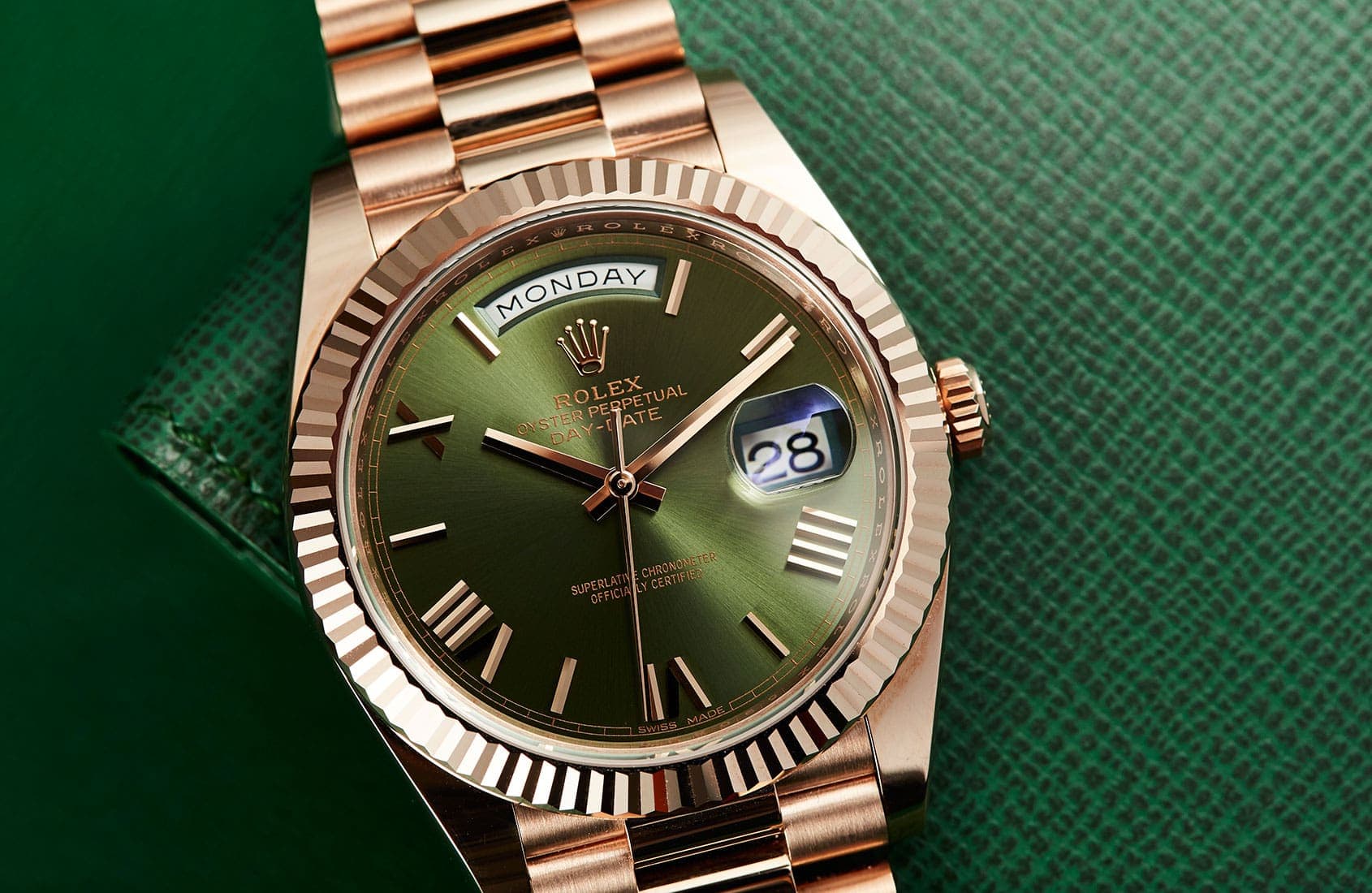
The Rolex Day-Date secondary market in the US is currently stable and rational after three years of correction from pandemic-era peaks. Most examples trade between 15–17% above retail MSRP ($40,000–$48,000 for yellow gold 36mm), with liquidity remaining strong because collector demand and global scarcity continue to support predictable resale. Timing, condition, reference year, and metal composition are the primary drivers of realized value; new buyers should expect 1–3 week transaction timelines and should prioritize authentication and service history over chasing price floors.
Quick Decision Snapshot
- Liquidity profile: High—Day-Date references sell in 5–21 days on active US platforms; yellow gold and white gold remain more liquid than platinum.
- Current value band: Yellow gold 36mm typically holds 15–17% above MSRP; steel Sport models command stronger premiums (20–35% range).
- Condition sensitivity: Unworn or recently serviced examples with original box/papers command 8–12% premiums over fair-condition pieces; heavy polishing reduces value 10–15%.
- Market phase: Post-correction stabilization (2023–2026); price floors are stable; speculative trading has cleared.
- Best entry windows: Fiscal quarter-ends (March, June, September, December) and during inventory clearing by secondary dealers.
Disclaimer: This analysis reflects US secondary market patterns and historical data. It is educational market guidance, not financial advice, and does not guarantee future pricing, liquidity, or outcomes.
What Actually Drives Value and Demand
The Rolex Day-Date does not appreciate uniformly. Metal type, service status, and production era are non-negotiable value signals; vintage and recently discontinued references trade at different multiples than current-production models.
The Day-Date has held secondary-market value better than most luxury watches because it combines professional utility, precious-metal durability, and limited annual production (Rolex makes approximately one million watches globally per year across all models). Global liquidity is exceptional—a Day-Date purchased in New York sells without friction in Dubai, Geneva, Hong Kong, or London.
Reality check: Not every Day-Date sells for above MSRP. Heavily worn examples, watches with missing service records, or pieces requiring immediate servicing often trade at 5–10% discounts to MSRP. Vintage references (1980s–1990s) sometimes fall below retail equivalents if the movement requires overhaul.
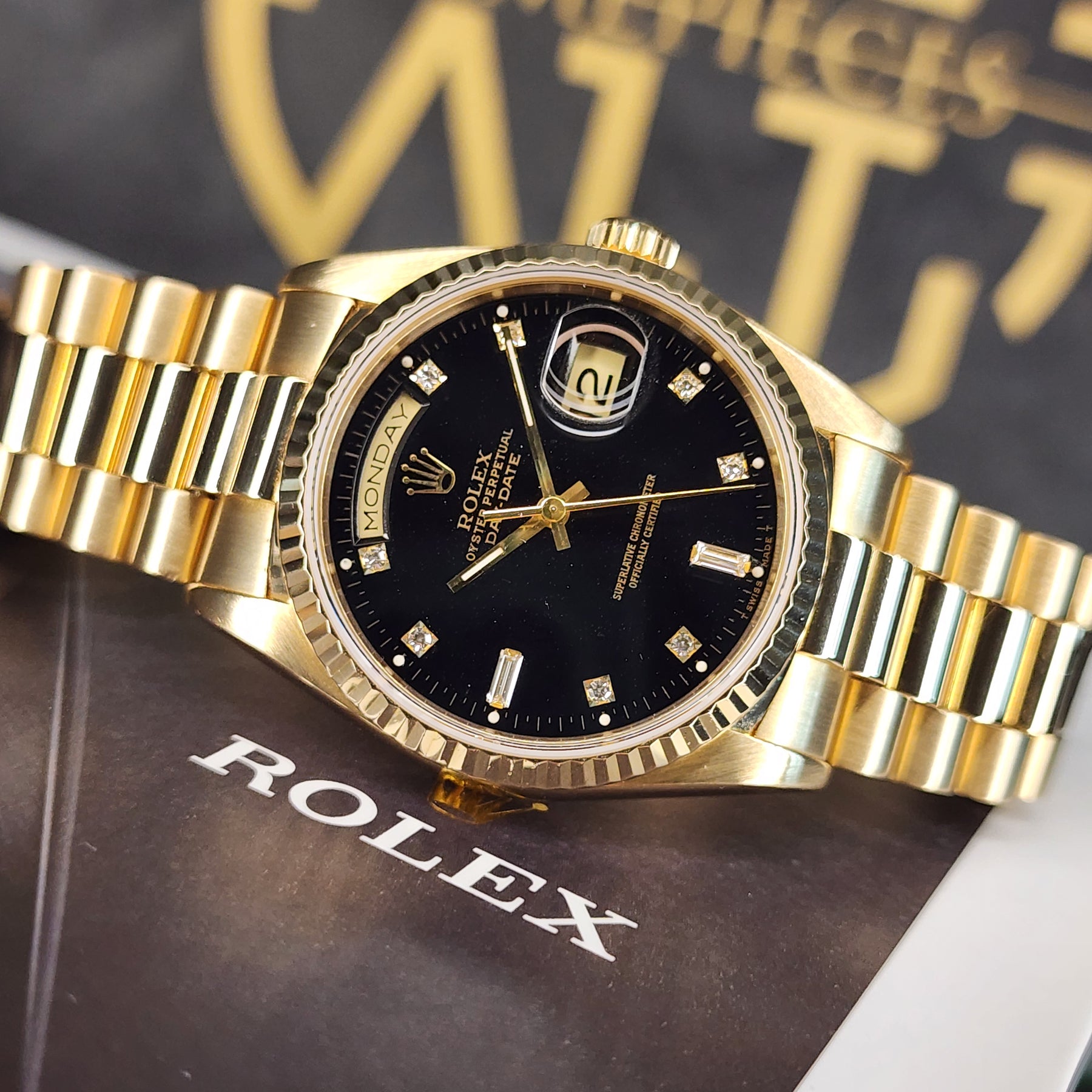
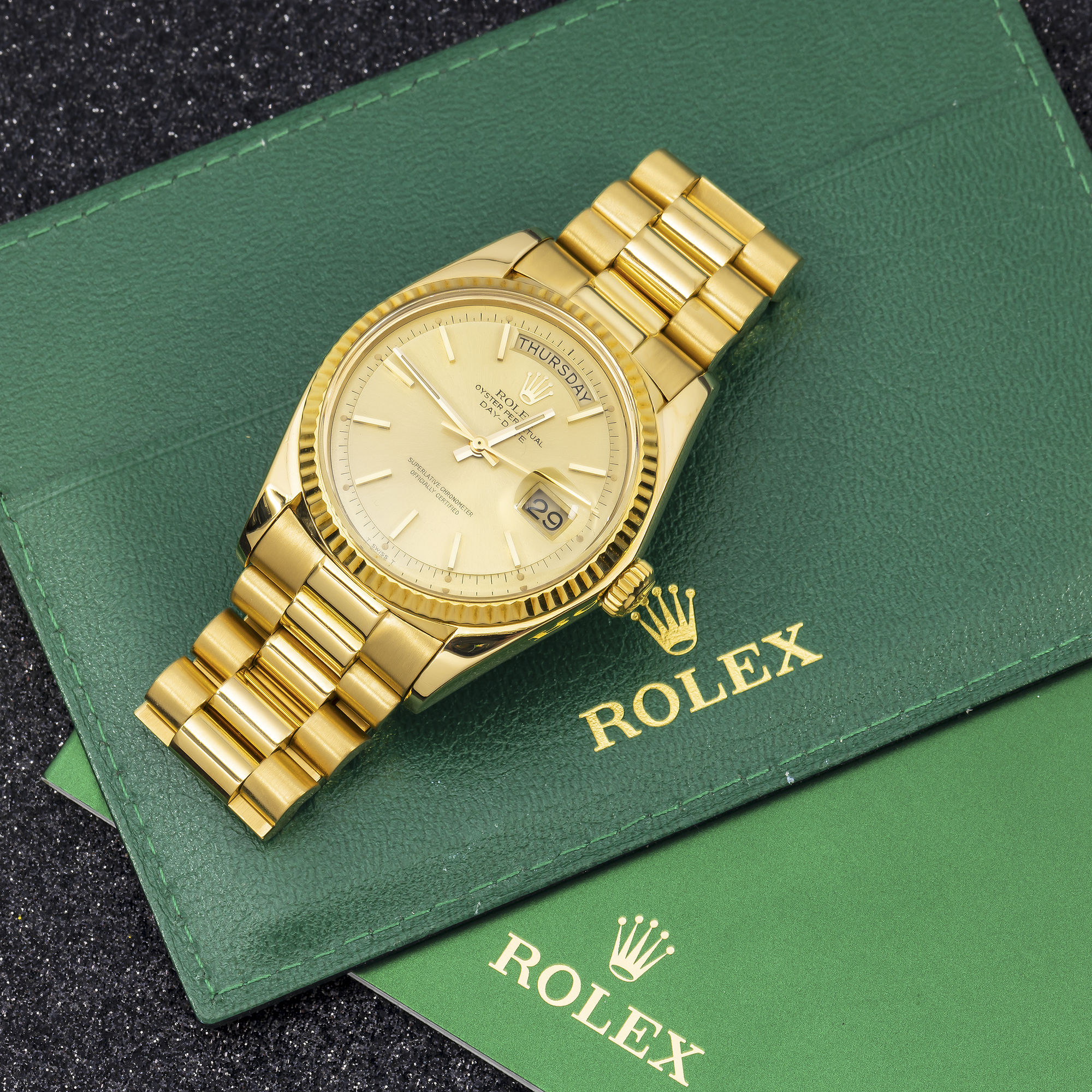
Example: A 1995 yellow-gold Day-Date President in fair condition (polished case, original Oyster bracelet, working movement) typically lists at $35,000–$38,000 on active US platforms. The same reference in unworn condition with original box and papers can reach $48,000–$52,000. That 30% spread reflects service risk and documentation confidence.

Category-Specific Evaluation Framework
The Day-Date’s secondary value depends on five measurable factors:
- Reference Number
- Current production (Ref. 128235 or newer) holds strongest premiums because warranty and service access are immediate.
- Discontinued references (Ref. 118238, 118209, 36mm steel sports models) trade at lower premiums but attract collectors seeking specific complications or dial options.
- Pre-2000 vintage references are valued more for collecting appeal than investment projection; condition and service history dominate pricing.
- Metal Composition
- Yellow gold (18K) maintains the most stable pricing across US market; global demand is consistent.
- White gold and rose gold command smaller premiums (1–5% variance) because secondary demand is narrower.
- Platinum remains illiquid in the US retail market; few dealers stock platinum Day-Dates, extending sale timelines to 30+ days.
- Condition Grade
- Unworn/New: Original box, papers, plastic, never worn. Commands +12–15% premium. Liquidity premium is real because risk is minimal.
- Mint: Polished or lightly worn, all papers and box. Typical MSRP parity or +5–8%.
- Good: Fair polish, light scratches, all papers. 5–10% discount.
- Service-Due: Functional movement, worn case, missing documentation. 15–25% discount; buyer must factor overhaul cost ($1,200–$2,000).
- Bracelet vs. Strap
- Original Oyster or Jubilee bracelet: +3–5% premium. Replacement bracelets reduce value 8–12%.
- Leather strap or aftermarket bracelet: no premium; buyers often factor cost to source correct bracelet.
- Service and Documentation
- Complete service history (Rolex or certified watchmaker records): +8–10% premium.
- Unknown service background: -15–20% reduction; buyer assumes risk.
- Original box and papers: +10% premium; papers alone add +5%.
Rolex’s Certified Pre-Owned program has raised secondary market expectations—even non-certified pieces now command higher prices if they carry service records or appear recently maintained.
Evaluation Workflow: The Five-Step Check
- Verify reference number and production year via serial number (Rolex.com or third-party databases).
- Photograph dial, case back, crown, and serial engravings; compare against known-good examples.
- Request service history, box, papers, and original documentation.
- Test movement accuracy (±10 seconds/day on a timing machine is acceptable).
- Inspect case for refinishing, rehab marks, or crown/tube replacement.
Pricing Mechanics and Trade-Offs
The US Day-Date secondary market operates on three overlapping channels: authorized dealers, marketplace platforms, and direct peer sales. Each channel imposes different pricing, speed, and margin trade-offs.
| Channel | Typical Price Range (36mm YG) | Liquidity Timeline | Buyer Risk | Best For |
|---|---|---|---|---|
| Authorized Rolex retailers | MSRP parity ($40K–$42K) | N/A (limited stock) | None; full warranty | New or nearly new; warranty priority |
| High-volume resellers | MSRP +10–15% ($44K–$48K) | 5–10 days | Low (authentication + history) | Speed + confidence |
| Marketplace platforms | MSRP +12–18% ($45K–$50K) | 7–21 days | Moderate (escrow mitigates) | Specific reference or dial |
| Peer sales / forums | MSRP +5–12% ($42K–$48K) | 14–30 days | High (peer verification only) | Collectors with patience |
Reality check: Faster sale timelines come at lower margins. A dealer liquidating stock at quarter-end may price 5–8% below market-ask to move inventory. Buyers who can act in 3–5 days often encounter better pricing than buyers shopping on 30-day cycles.
Example: A seller holds a yellow-gold 36mm Day-Date (2019, mint condition, all papers, Oyster bracelet). On a high-volume platform, asking price is $47,500. After a 5-day listing, no bids. On day 10, a floor-level offer at $43,200 arrives. The seller faces a choice: hold and wait (risk), or accept a 9% margin reduction for immediate certainty. Secondary market behavior is rational, not emotional—price always moves toward cash velocity.
| Margin Driver | Impact on Realized Price | Buyer Control |
|---|---|---|
| Inventory age (for dealer) | 3–8% discount if clearing old stock | Limited; external timing |
| Fiscal calendar (Q-end pressure) | 5–7% reduction possible | High; buy during March/June/Sept |
| Service completion before sale | +10–12% if recently serviced | High; prioritize service |
| Documentation completeness | +8–15% premium for papers/box | High; source correct docs |
| Metal/reference rarity | ±5–20% depending on model | None; inherent to watch |
Risk Control and Authentication Workflow
The US secondary Rolex market is mature and well-policed, but counterfeits exist and refurbished movements occasionally masquerade as original. Buyers must verify authenticity at three checkpoints: provenance, physical inspection, and movement validation.
- Serial number validation: Cross-reference with Rolex production databases (year ranges, reference compatibility). Mismatches signal refurbished cases or case swaps.
- Dial printing and lume color: Counterfeit dials show uneven printing, wrong font thickness, or lume color that does not match period-correct examples. High-resolution photos under 10x loupe are essential.
- Case finishing and crown logo: Rolex crowns are precisely engraved; reproductions show rounded or uneven edges. Case finishing (brushing, polishing) follows strict Rolex specs; aftermarket work is visible to trained eye.
- Movement inspection: Request high-resolution photos of movement. Rolex calibers are numbered and dated; ask seller for specifics. Refinished or replaced components reduce value 20–30%.
- Bracelet end links and stamping: Original Rolex end links carry precise stamping (reference, serial markings). Counterfeit links show poor resolution or missing details.
Before committing capital, engage a third-party authenticator (watchmaker or certified appraiser) for $150–$300. This cost is recovered many times over if it prevents a counterfeit or over-serviced purchase.
Action Plan by Intent (Sell / Buy / Source / Appraise)
If You Are Selling
Your goal is to maximize realized proceeds while minimizing holding time. Pricing strategy depends on urgency.
| Seller Intent | Best Channel | Timeline | Price Expectation | Effort |
|---|---|---|---|---|
| Maximize price (patient) | Marketplace + forums | 21–45 days | MSRP +15–18% | High; marketing required |
| Balanced (moderate timeline) | High-volume reseller | 7–14 days | MSRP +10–14% | Low; single negotiation |
| Quick liquidity (urgent) | Dealer buyback / wholesale | 1–3 days | MSRP +5–8% | Minimal; one conversation |
Numbered steps for a managed sell process:
- Gather documentation. Collect original box, papers, warranty card, service receipts, purchase invoice if available. Photograph all items and movement.
- Determine accurate condition grade. Use the five-tier framework (Unworn, Mint, Good, Fair, Service-Due). Be honest; overgrading reduces buyer confidence and extends sales timeline.
- Price conservatively against comps. Search 3–5 recent sales of identical references on marketplace platforms. List 2–3% above most recent comp (not outliers).
- Disclose service history fully. Mention any non-Rolex servicing, movement adjustments, or replacement parts. Transparency builds buyer confidence and justifies premium pricing.
- Respond fast to inquiries. Buyers who contact you within 48 hours of listing are serious. Slow responses kill deals.
- Arrange third-party authentication if asked. Offer to cover authentication cost; it signals confidence and accelerates closing.
Example: You own a 2015 yellow-gold 36mm Day-Date President (mint condition, all papers, Oyster bracelet, last serviced 2023 by authorized dealer). You list at $46,800 on a marketplace platform. Within 5 days, you receive three inquiries: $44,200 (lowball), $46,000 (walk-up), $46,500 (serious). You negotiate with the third buyer to $46,650 and close within 10 days. Total holding cost: $250–$400 (platform fees). Proceeds: $46,250.
If You Are Buying
Your goal is to acquire a specific reference at fair value while controlling authentication risk. Timing and patience are profit centers.
Numbered steps for a managed buy process:
- Define your target precisely. Reference number, metal, production era, dial type (champagne, silver, other), condition tolerance, and maximum price. Specificity eliminates emotional overpaying.
- Monitor all channels simultaneously. Set alerts on marketplace platforms, follow dealer inventory feeds, and join collector forums. Price discovery takes 2–4 weeks if you are patient.
- Identify fiscal windows. Watch for year-end or quarter-end inventory pushes (December, March, June, September). Pricing softens measurably during these periods.
- Engage authentication early. Do not bid until you have reviewed high-resolution photos and confirmed reference number compatibility with production year.
- Negotiate on service, not price. If a watch is service-due, offer $2,000–$3,000 less than asking and budget for professional overhaul. This shift prevents price stalls.
- Close with escrow or verified payment. Never wire funds without escrow protection or buyer-protection guarantees from the platform.
Example: You are seeking a 1999 yellow-gold 36mm Day-Date (Ref. 18238, any dial). Maximum budget: $38,000. You search for 6 weeks across three platforms. In week 7, a dealer lists a matching reference in good condition (light polishing, all papers, two-tone Oyster/strap, service history unknown) at $39,200. You offer $36,500, negotiating on the condition and unknown service. Dealer counters at $37,800. You agree, arrange escrow, and execute.
Appraisal and Condition Assessment
If you need a professional valuation (insurance, estate, divorce, due diligence), engage a certified appraiser or established dealer. Appraisals typically cost $200–$400 and include a detailed written assessment.
Reality check: Appraisal value and resale value are not equivalent. Appraisers often use conservative replacement-cost models, which can run 10–20% higher than actual secondary-market pricing. Use appraisals for insurance purposes; use marketplace comps for resale planning.
Sourcing for Inventory (Dealers / Resellers)
If you are building inventory, your margin framework depends on sourcing cost, refurbishment budget, and market timing.
- Target sourcing cost: MSRP –5% to MSRP +10%. Below that range, quality is suspect; above that range, your gross margin (spread between cost and retail ask) becomes uncompetitive.
- Budget for refurbishment: Plan $600–$1,500 per watch for professional cleaning, movement verification, and bracelet detailing. Service work ($1,200–$2,000) should be buyer responsibility unless you are targeting premium inventory.
- Hold time: Plan 10–21 days average. Watches that don’t move in 30 days should be repriced downward 3–5%; stale inventory erodes margins.
- Channel strategy: High-volume platforms for commodity examples; marketplace and direct sales for rare references or condition standouts.
Bullet list: What we need to move fast
- Brand and model: Rolex Day-Date, reference number (e.g., 128235, 118238).
- Metal composition: Yellow gold, white gold, two-tone, platinum; weight (if known).
- Condition description: Photos of dial, case, bracelet, movement (high resolution, 10x loupe where possible).
- Documentation: Box, papers, service history, warranty card, original receipts.
- Service status: When last serviced, by whom, any non-original parts or repairs.
- Location: US state/metro area (affects shipping and local buyer pool).
- Timeline: Are you buying, selling, or appraising? What is your urgency window?
FAQ
1. Why does the Rolex Day-Date hold value better than sport models in the secondary market? The Day-Date (President) has steady professional and dress-watch demand. It is not as collectible as vintage references or sport chronographs, but it trades consistently because it suits working professionals and does not fall out of favor like trend-driven luxury goods. Global liquidity is high because it is recognized in every major market.
2. What is the realistic secondary-market price for a gold Rolex Day-Date right now? A 36mm yellow-gold Day-Date retailing at approximately $40,250–$42,000 (MSRP) typically sells for $45,000–$48,000 on the US secondary market, representing a 12–15% premium. Price depends on reference age, condition, and documentation. Vintage references (pre-2000) may trade below MSRP if service history is unclear.
3. Are Rolex watches still a good investment, or is the bubble over? Rolex is no longer a speculative asset; it has returned to behaving as a stable alternative asset class with 6–7% annualized appreciation and strong value retention. It is not a guaranteed investment, and timing, condition, and reference selection matter. Buy for utility and long-term stability, not flipping profits.
4. What time of year should I buy a Rolex Day-Date to get the best pricing? Fiscal quarter-ends (March, June, September, December) often feature dealer inventory clearing and aggressive pricing. Secondary-market platforms typically see softer pricing during economic downturns or periods of high inventory levels. Patience over 4–6 weeks usually uncovers better comps than buying on the first available listing.
5. Does a Rolex need to be certified pre-owned to hold value on resale? No, but Rolex Certified Pre-Owned watches command 5–10% premiums because the brand backs the authentication and offers warranty coverage. Non-certified watches sell for slightly less but are still liquid if condition and documentation are strong. Rarity and condition matter more than certification.
6. How can I tell if a Day-Date I’m buying is authentic? Check the serial number against Rolex production databases; verify dial printing and lume color match known examples; inspect the crown engraving under magnification; confirm the movement caliber and date with the reference number; and request high-resolution photos of all case markings and the movement. For $200–$300, a certified appraiser can provide written authentication that protects your investment.
7. What factors cause Day-Date prices to drop on the secondary market? Excessive polishing or refurbished movements, missing original documentation, unknown service history, and dated references (10+ years old without recent service) typically result in 10–25% price reductions. Market-wide corrections (like 2022–2024) also soften pricing, but these are temporary and usually reverse over 18–36 months.
8. Is it better to buy a Day-Date or a Submariner if I want strong resale value? Submariners and sports models command higher premiums in percentage terms (25–40% above MSRP) because supply is more constrained. Day-Dates hold value reliably (12–17% premiums) but do not appreciate as aggressively. Choose based on utility; both are liquid on the US secondary market.
9. What does “value retention” mean, and why did Rolex’s value retention drop to +15.7%? Value retention is the percentage of MSRP that a watch retains when resold. Rolex’s +15.7% value retention means the average Rolex still commands 15.7% above retail price. This ratio dropped from earlier years because Rolex increased retail pricing faster than secondary-market values climbed, but the absolute resale prices remain healthy.
10. How long does it typically take to sell a Day-Date on the US secondary market? High-volume dealers and platforms typically move inventory in 5–14 days. Peer sales and forums can extend timelines to 14–30 days. Stale listings (30+ days) usually indicate overpricing or low buyer demand for that specific reference. Patience-driven sellers pricing conservatively usually close within 10–15 days.
Atlas Luxury content is built from active US market monitoring, authentication workflows, and transaction-level buyer/seller patterns across secondary platforms. Our analysis reflects real market behavior, not manufacturer guidance or speculative positioning.