Key Takeaways:
- Comfort: Jubilee wins decisively due to smaller links and superior articulation (“drape”).
- Scratches: Jubilee hides scratches better than the Oyster’s polished center links (PCL).
- Durability: Modern Oyster bracelets remain structurally stronger, but post-2018 Jubilees feature ceramic tube inserts that virtually eliminate “stretch.”
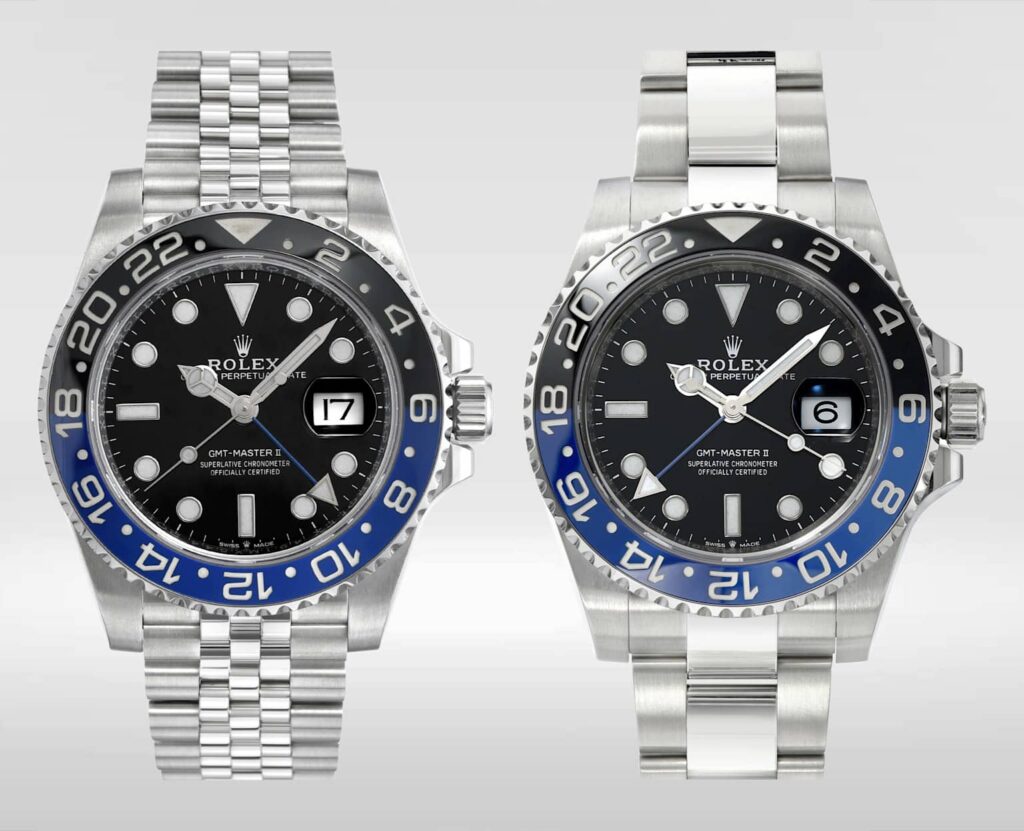
- Value: On models like the GMT-Master II, Jubilee-equipped watches (“Batgirl”) often command a slight secondary market premium over Oyster versions (“Batman”).
Design Philosophy & Origins
The Oyster (1930s): The Tool Watch Standard
Rolex’s Oyster bracelet emerged in the 1930s as a masterpiece of functional simplicity. The original three-link design prioritized durability, diving capability, and speed of repair—if a link broke, a watchmaker could replace it without proprietary tools. The broad, flat surfaces were easy to brush, easy to clean, and built to withstand the rigors of active use.
This utilitarian philosophy extended to professional models like the Submariner and Daytona, where the Oyster remains the only bracelet option. Rolex never offers these sports watches on Jubilee precisely because the tool-watch heritage demands structural robustness over aesthetic sophistication.
The Jubilee (1945): The Dress Alternative
In 1945, celebrating Rolex’s 40th anniversary, the brand launched something radically different—the Jubilee bracelet. Originally exclusive to the Datejust, the five-link semi-circular design was intentionally engineered to look and feel like fine jewelry. The Jubilee wasn’t about durability or tool-watch function; it was about elegance, drape, and catching light.
For decades, the Jubilee remained a dress-watch staple, appearing primarily on Datejusts and Day-Dates. The pivotal moment came in 2018 when Rolex offered the GMT-Master II on Jubilee—creating the “Pepsi” and later the “Batgirl”—fundamentally changing perceptions of the bracelet from “grandpa’s watch” to “coveted hype piece.”
Round 1: Comfort and Fit on the Wrist
The “Drape” Factor: Why Jubilee Feels “Silky”
Put both bracelets on your wrist, and the difference emerges instantly. The Jubilee’s five smaller links provide numerous articulation points, allowing the bracelet to conform perfectly to your wrist’s natural shape—whether round, flat, or asymmetrical. This flexibility creates the “silky” sensation enthusiasts praise: the bracelet almost disappears on your arm.
The Oyster, with its three larger links, feels more structured and anchored. It maintains its shape rather than adapting to yours. For people with larger wrists or those who prefer a “secure” feeling, this rigidity feels reassuring. For people with smaller wrists (6.5 inches or below), the Jubilee’s superior flexibility often makes the difference between comfortable all-day wear and noticeable pressure.
Breathability in Summer
An overlooked advantage: airflow. The Jubilee’s gaps between five links allow air to circulate, minimizing sweat buildup during hot weather or exercise. The Oyster’s flat, broad surfaces create a more enclosed feeling against skin, sometimes feeling sticky in humid climates.
Hair Pulling: Debunking the Myth
There’s persistent folklore that Jubilees “pull arm hair.” This was genuinely true for vintage hollow-link Jubilees from the 1960s–1980s. Modern Jubilees (manufactured since approximately 2015) feature solid links throughout, virtually eliminating the hair-pulling issue.
The modern Jubilee’s superior manufacturing doesn’t entirely prevent hair interaction, but it’s become rare enough that it shouldn’t factor into your decision.
Round 2: Durability and Scratch Resistance
Hiding Scratches: The Jubilee Advantage
Here’s the counter-intuitive truth: the Jubilee—often perceived as a delicate dress bracelet—hides scratches better than the tool-watch Oyster. The reason is pure geometry.
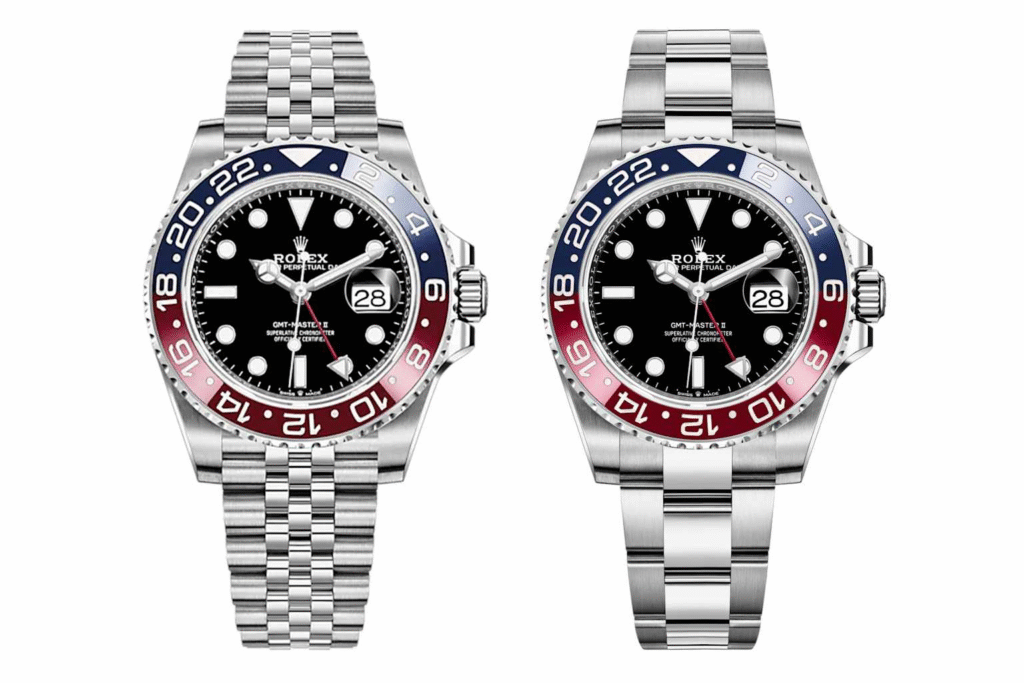
The Jubilee’s busy five-link pattern creates multiple reflective facets and angles. Light scatters across these surfaces, and hairline scratches virtually disappear under magnification of normal viewing. Contrast this with the Oyster’s polished center links (on modern GMTs and Daytonas), which function as scratch magnets—any tiny scuff becomes a visible line under certain light angles.
| Scratch Visibility | Oyster | Jubilee |
|---|---|---|
| Polished surfaces | High visibility | Multiple angles hide marks |
| Daily wear scratches | Prominent at certain angles | Nearly invisible |
| Resale appearance | Shows wear more obviously | Maintains “newer” appearance |
This explains why Jubilee watches often appear in better condition than equally worn Oyster models—the scratches are there, but hidden by design.
The “Stretch” Issue: Myth vs. Reality in 2025
Vintage Jubilees genuinely suffered from “bracelet stretch”—the hollow links and thin pins would wear over decades, creating noticeable sag that required professional service. This reputation haunts the Jubilee even today, despite being largely solved.
Modern manufacturing (2015 onwards) introduced solid links with ceramic tube inserts inside the pins. These ceramic tubes dramatically reduce metal-on-metal friction, virtually eliminating the wear that caused stretch in older models. Additionally, Rolex strengthened the overall link construction, increasing pin diameter tolerances.
The result: post-2018 Jubilees are structurally equivalent to Oyster bracelets in terms of resistance to mechanical stretch. Both will function perfectly after 20+ years of daily wear.
Structural Integrity: Why Oyster Remains Superior for Active Sports
Despite modernization, the Oyster’s simpler three-link construction provides superior impact resistance. During sudden forces (golf swings, tennis serves, diving impacts), the Oyster’s larger links compress and return to shape more reliably. The Jubilee, with its numerous articulation points, theoretically disperses impact energy less efficiently.
For serious athletes or professionals exposing watches to extreme conditions, the Oyster’s robustness remains a legitimate advantage.
Round 3: Aesthetics and Versatility
The “Old Man” Stigma vs. Modern Hype
Before 2018, the Jubilee’s association with Datejusts and Day-Dates created an unfortunate cultural perception: it was a “grandfather’s bracelet.” The turning point came with the Pepsi GMT-Master II on Jubilee (2018) and Batgirl GMT-Master II on Jubilee (2019). Suddenly, the Jubilee became the hype piece, coveted by younger collectors who appreciated its refined aesthetic.
Today’s Jubilee has completely shed this stigma, now representing sophistication and insider knowledge rather than old-fashioned tradition.
Formal vs. Casual
The Oyster (particularly all-brushed versions on Submariners and Explorers) excels with casual dress—T-shirts, jeans, weekend wear. Its understated tool-watch aesthetic requires no apology or explanation.
The Jubilee bridges formality and casualness in ways the Oyster cannot. Wear it with jeans on Friday, and it looks refined. Wear it under a suit cuff on Monday, and it communicates horological sophistication. The Jubilee is the only steel Rolex bracelet that genuinely “passes” for dressier occasions.
The Visual Size Effect
Counterintuitively, Jubilee bracelets make watch cases visually larger through the busy link pattern directing attention toward the center case. Oyster bracelets, with their streamlined simplicity, can make large cases appear proportionally smaller.
Round 4: Clasps and Adjustability
Oysterlock vs. Crownclasp
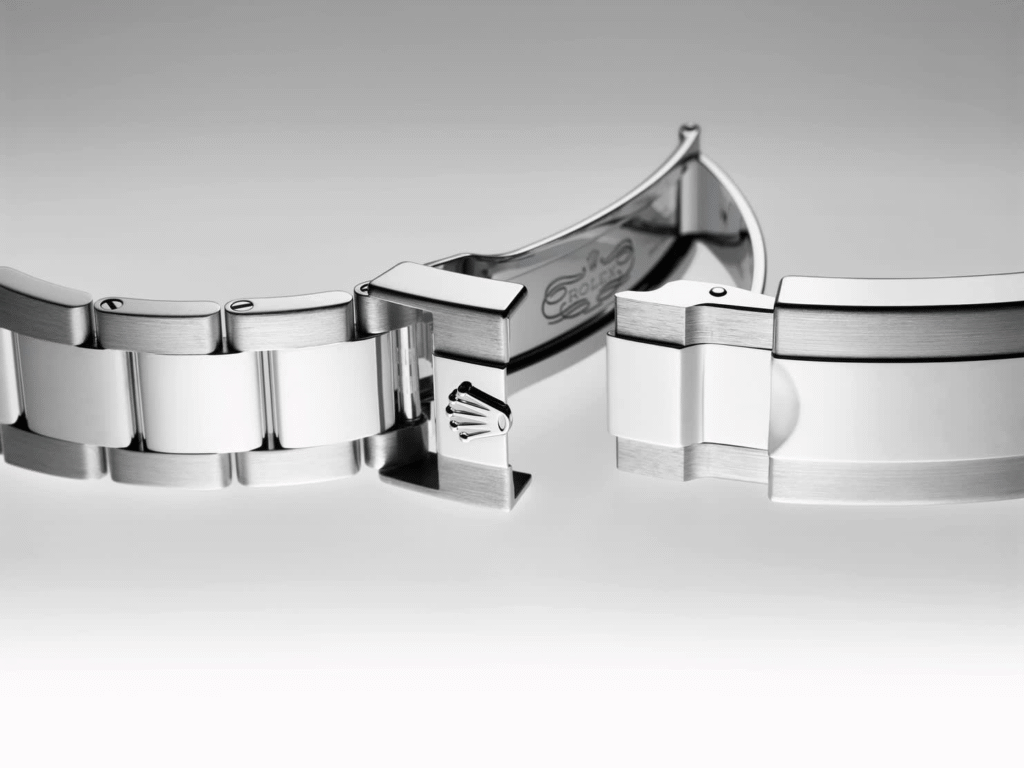
Oyster bracelets typically feature the robust Oysterlock—a double-security clasp with fold-over safety lock, designed for durability and peace of mind during active wear.
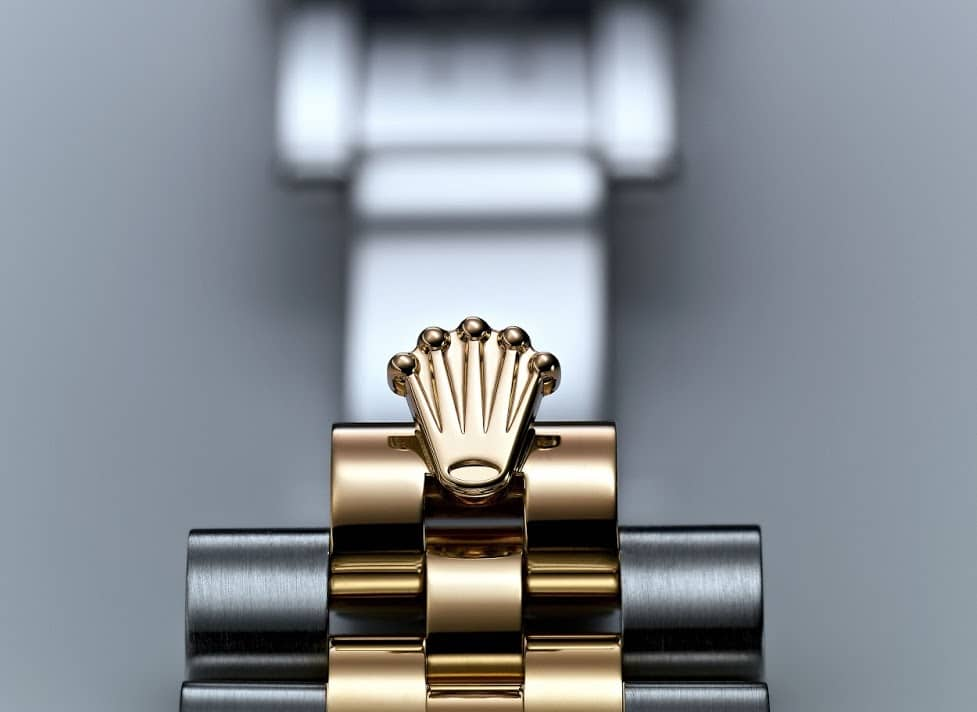
Jubilees historically featured the Crownclasp (concealed deployment clasp), hidden beneath the bracelet surface for clean aesthetics. However, modern Jubilees on sport models like the GMT-Master II now use the Oysterlock system for security consistency.
Easylink vs. Glidelock
Most Jubilees come with Easylink—a simple 5mm extension mechanism perfect for warm days or wetsuits. Certain Oyster models (notably Submariners) feature Glidelock—a 20mm infinite slide-extension offering superior flexibility for varied wearing conditions.
For GMT-Master II models, both bracelets now standardly feature Easylink, minimizing this differentiation.
Can You Swap Them?
Technically, many GMT-Master II models accept both Oyster and Jubilee bracelets—but swapping requires precision. End-links differ between bracelet types, and forcing incompatible configurations can damage lugs. Additionally, Rolex explicitly designed the two-tone ceramic GMT to prevent Oyster-to-Jubilee conversion, preserving the white-gold model’s exclusivity.
Market Value Analysis: The “Batgirl” vs. “Batman” Effect
Retail Price Differences
At authorized dealers, the Oyster and Jubilee version of the same watch cost approximately $200 difference at MSRP—Rolex prices bracelets comparably, treating them as stylistic choices rather than quality differentials.
Secondary Market Premiums
This is where the narrative shifts dramatically. On secondary markets, the Jubilee often trades faster and at slight premiums compared to Oyster versions, particularly for sought-after models like the GMT-Master II.
| Model | Oyster Secondary (2025) | Jubilee Secondary (2025) | Premium |
|---|---|---|---|
| GMT-Master II “Batman” | $18,000–$25,000 | N/A (discontinued 2019) | N/A |
| GMT-Master II “Batgirl” | N/A (not available) | $16,000–$20,000 | N/A |
| Datejust 41 | $8,500–$11,000 | $8,800–$11,500 | +$300–$500 |
The Batgirl’s relatively lower secondary price compared to the discontinued Batman reflects availability rather than quality—the Batgirl is still being produced, reducing scarcity value.
Resale Liquidity
Jubilee watches currently sell faster with more buyer interest, though the Oyster maintains broader appeal across age demographics. For serious investors seeking rapid secondary market conversion, the Jubilee offers tactical advantages.
Summary Comparison Table
| Feature | Oyster | Jubilee |
|---|---|---|
| Comfort | Good, structured | Excellent, drapes perfectly |
| Scratch Hiding | Polished links show marks | Multiple angles hide scratches |
| Sportiness | Superior for active use | Adequate for most activities |
| Formal Wear | Can feel too casual | Bridges formal/casual perfectly |
| Stretch Risk (Modern) | None | Virtually none (ceramic inserts) |
| Visual Size Effect | Makes case appear smaller | Makes case appear larger |
| Breathability | Less airflow | Better airflow, less sweat |
| Secondary Market Speed | Steady demand | Faster sales, higher interest |
Final Verdict: Which One Should You Choose?
Choose Oyster If:
- You swim daily or engage in regular water sports
- You prefer an understated, tool-watch aesthetic
- You want an “investment-proof” bracelet requiring minimal aesthetic consideration
- You prioritize rugged durability over comfort nuances
- You value simplicity and ease of cleaning
Choose Jubilee If:
- Comfort is your priority—all-day wearing without pressure
- You wear business formal attire regularly and want a watch that transitions seamlessly
- You dislike visible scratches and prefer the illusion of pristine condition
- You want your watch to look more expensive and jewelry-like
- You appreciate refined elegance and nuanced design
- You’re considering secondary market resale, where Jubilee demand remains strong
Conclusion: The Modern Reality
In 2025, the choice between Jubilee and Oyster is fundamentally a lifestyle and aesthetic decision, not a durability one. Modern manufacturing has eliminated the structural weaknesses that once made this a legitimate durability trade-off.
Wear the Oyster if tool-watch simplicity speaks to your wrist. Wear the Jubilee if refined comfort and versatility matter more. Both will perform flawlessly for decades.
The real question isn’t which is objectively better—it’s which reflects how you actually live.