
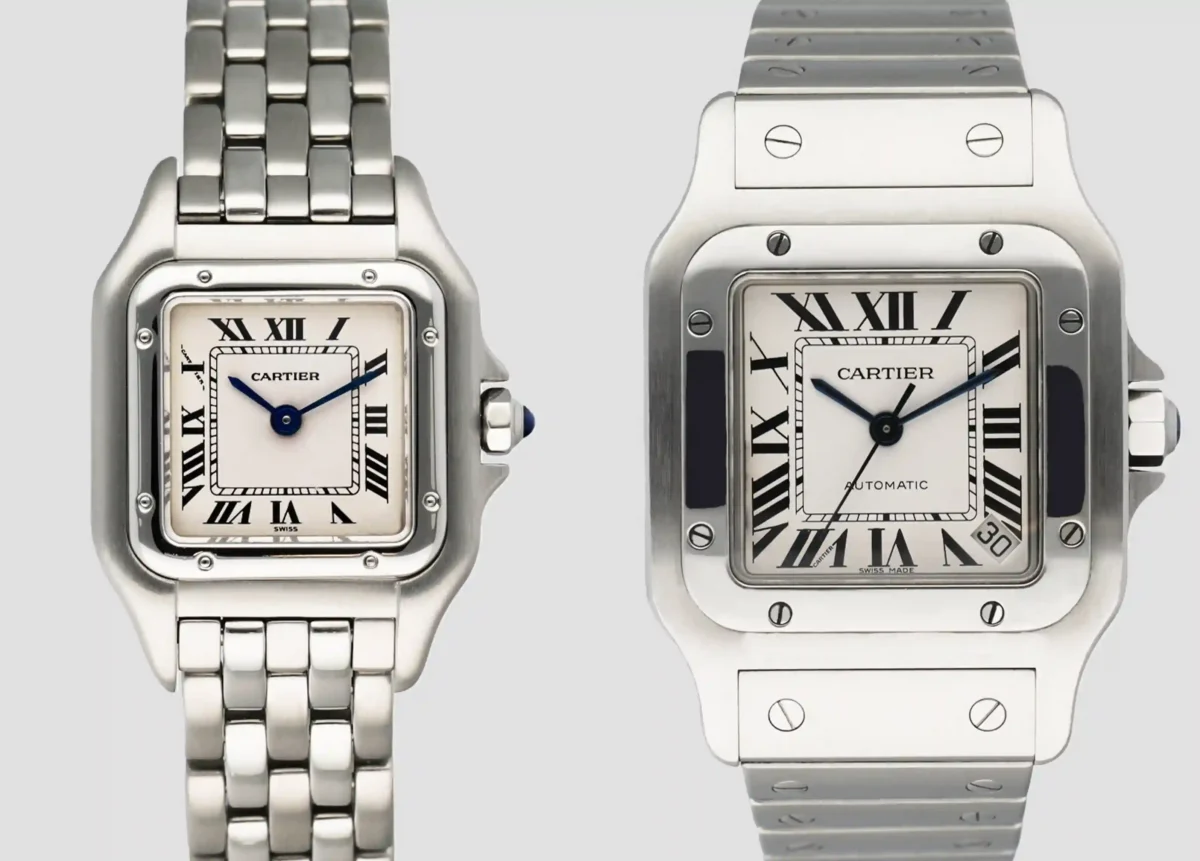
When Louis Cartier sketched the Santos in 1904 and the Tank in 1917, he established watchmaking principles that remain fundamentally unshaken more than a century later. Yet despite sharing the same visionary designer, the same prestigious Cartier name, and fundamentally similar positioning as luxury watches, the Santos and Tank represent diametrically opposed design philosophies—one celebrating industrial boldness, the other embracing refined elegance. Understanding which shaped watch aligns with your aesthetic, lifestyle, and personality requires more than casual comparison; it demands appreciation for how design shapes daily experience.
Origins: A Century of Iconic Design
The Santos: The World’s First Pilot’s Watch (1904)
The Santos emerges from the cloudless Parisian sky in 1904 when Louis Cartier encountered a practical problem: his friend, Brazilian aviation pioneer Alberto Santos-Dumont, couldn’t read his pocket watch while piloting his biplane without removing his hands from the aircraft controls.
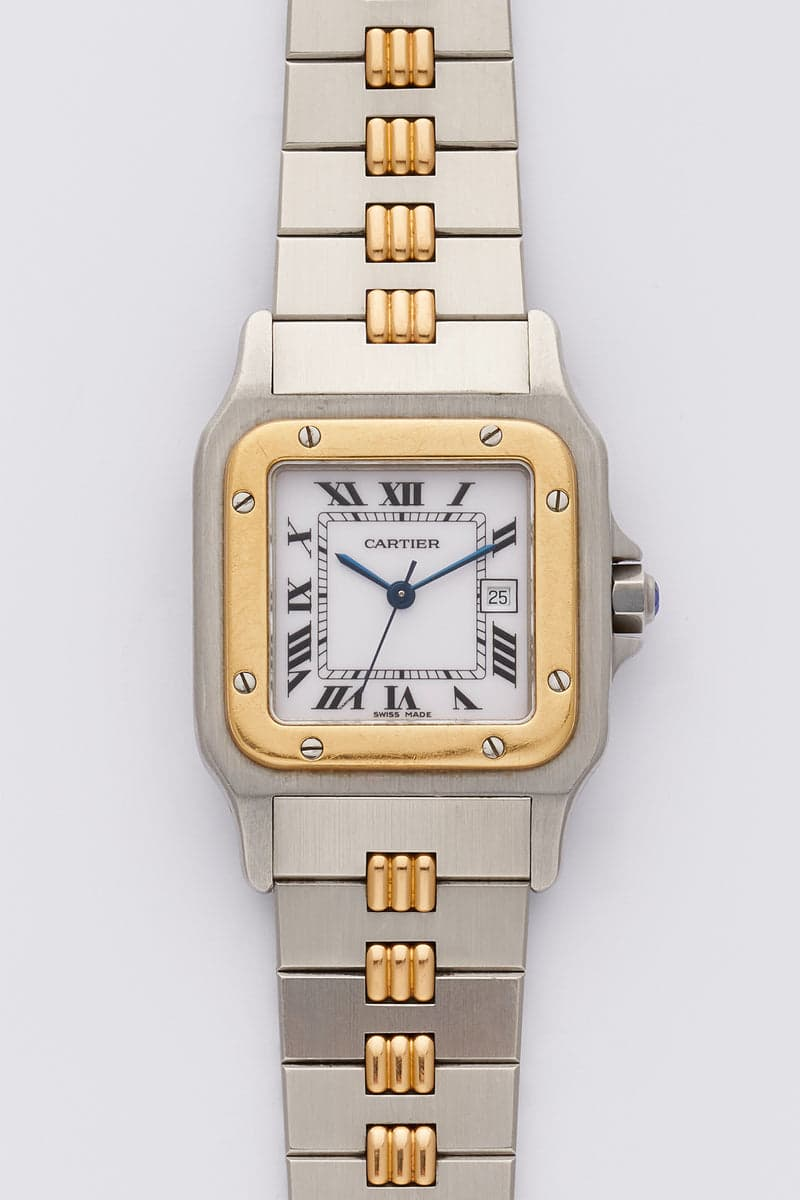
Cartier’s solution revolutionized horology itself. In collaboration with Edmond Jaeger, he created the first men’s wristwatch—a square platinum case with exposed hexagonal screws securing the bezel, Roman numerals on the dial, and a leather strap with a folding buckle. This wasn’t jewelry masquerading as practicality; it was genuine tool design for a pioneering age.
When Santos-Dumont flew publicly in October 1906 (making history’s first filmed airplane flight), he wore the Cartier—cementing the watch’s association with aviation adventure and practical courage. The watch wasn’t officially released to the public until 1911, by which point Santos-Dumont’s celebrity status had already transformed the Santos from functional tool into cultural icon.
The Tank: Inspired by Mechanized Warfare (1917)
While the Santos celebrated aviation’s freedom, the Tank emerged from World War I’s mechanized brutality. In 1917, Louis Cartier designed the Tank by drawing direct inspiration from the Renault FT-17 tank’s geometric silhouette—specifically the top-down aerial view.
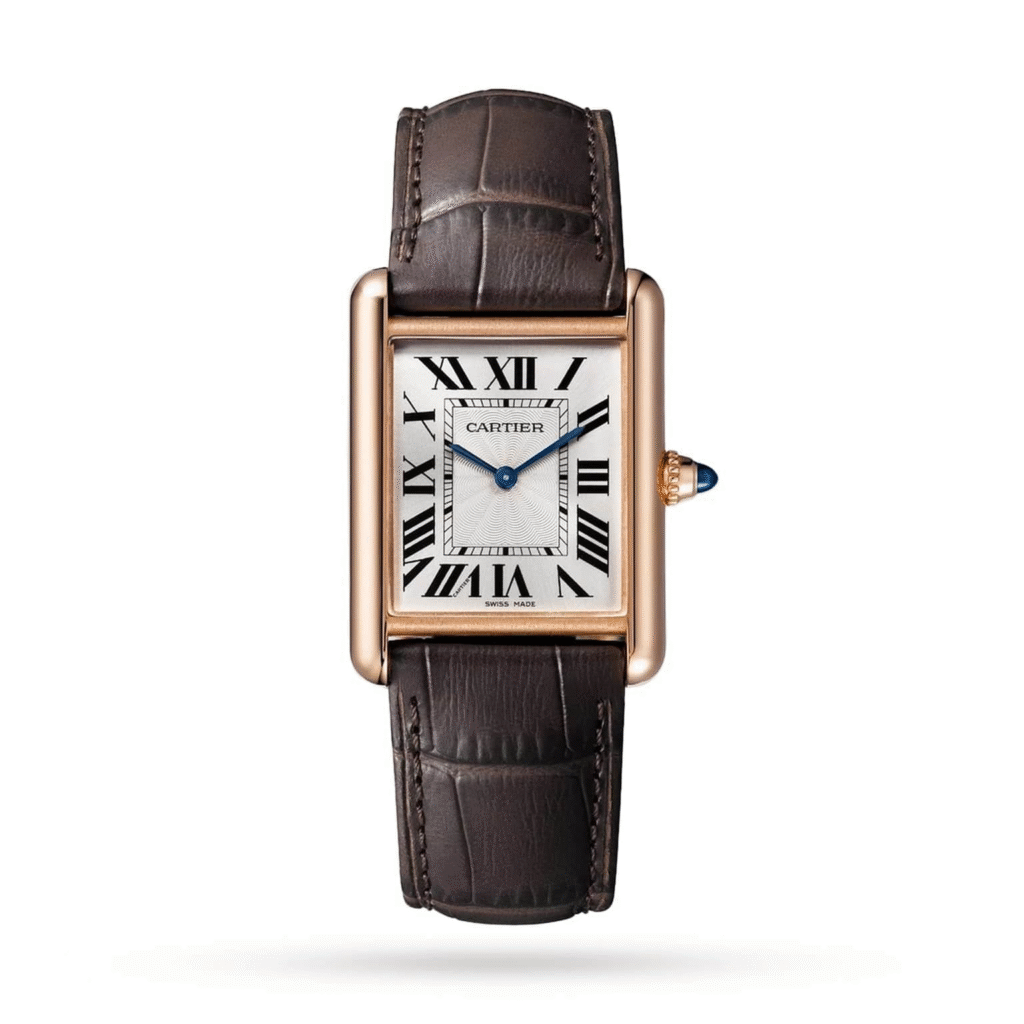
The Tank’s rectangular case mirrors the tank’s cockpit, while the vertical case sidebars (called “brancards”) echo the vehicle’s treads. Roman numerals adorn the dial, and a thin minute track (called “chemin de fer,” or railway) runs around the inner dial—references to refined horology rather than mechanical warfare.
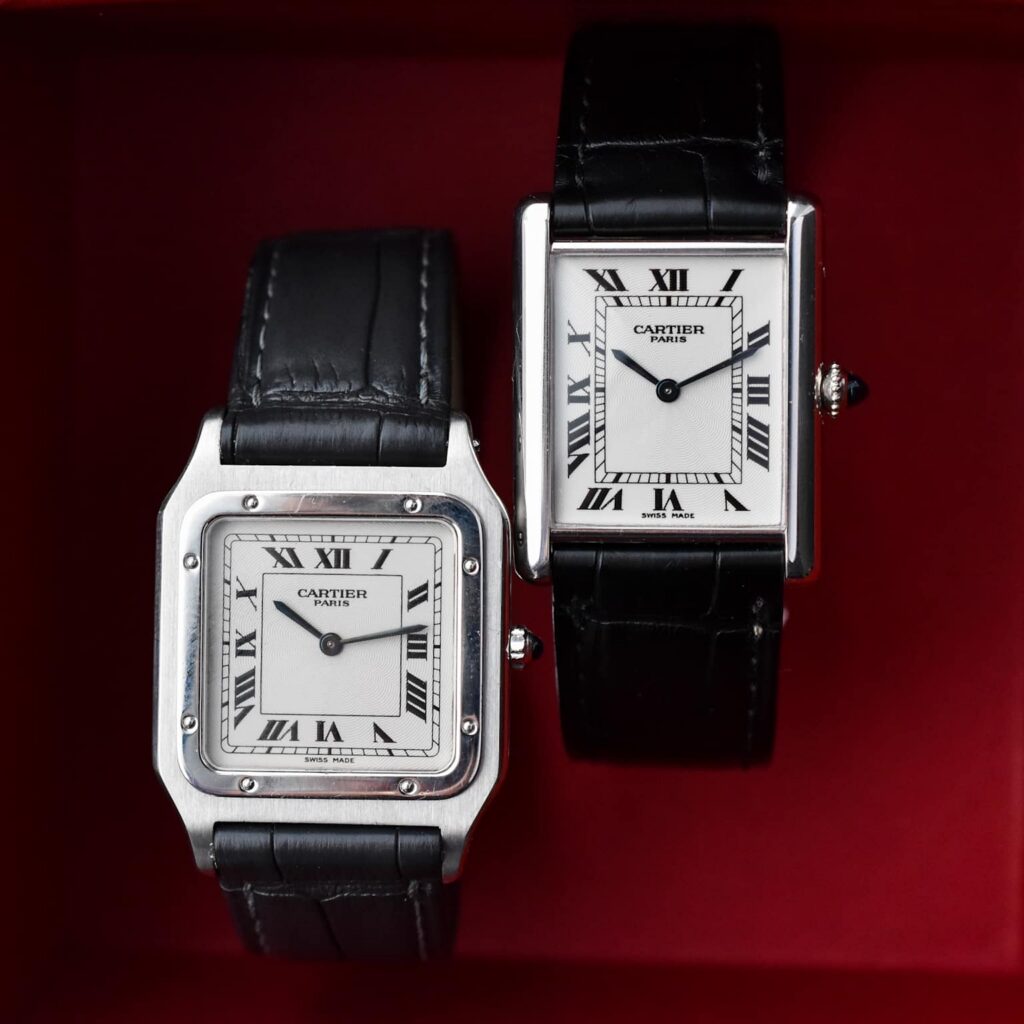
Where the Santos celebrated individual pilot heroism, the Tank represented organized military precision. Where the Santos embraced exposure (visible screws, mechanical visibility), the Tank pursued refinement through understatement (minimal dial, elegant lines, psychological reserve).
Design Philosophy: Bold vs. Refined
| Aspect | Santos | Tank |
|---|---|---|
| Case Shape | Square with rounded transitions | Rectangular (wider than tall) |
| Bezel Signature | Exposed hexagonal screws (8 total) | Polished bezel without screws |
| Bracelet/Strap Default | Metal bracelet + interchangeable straps | Leather strap (primary identity) |
| Dial | Sword hands, minimal indices | Breguet hands, Roman numerals |
| Visual Weight | Pronounced, demanding attention | Restrained, whispers elegance |
| Comfort Philosophy | Confidence-building boldness | Quiet sophistication |
| Aesthetic Category | Sports luxury | Dress luxury |
| Best Wearing Context | Business-casual to weekend | Business formal to special occasions |
Santos: Industrial Confidence
The Santos makes no apologies for its presence. Exposed screws—eight hexagonal fasteners that visually bracket the bezel—announce that this is a functional instrument, not jewelry pretending to be a watch. The square case with rounded lugs creates psychological authority; it sits decisively on your wrist like a statement.
This boldness emerged from aviation culture, where visibility and readability mattered more than elegance. The exposed screws served practical purposes (securing the bezel to the case), but Cartier’s decision to celebrate rather than conceal them signaled that functional necessity could equal design excellence.
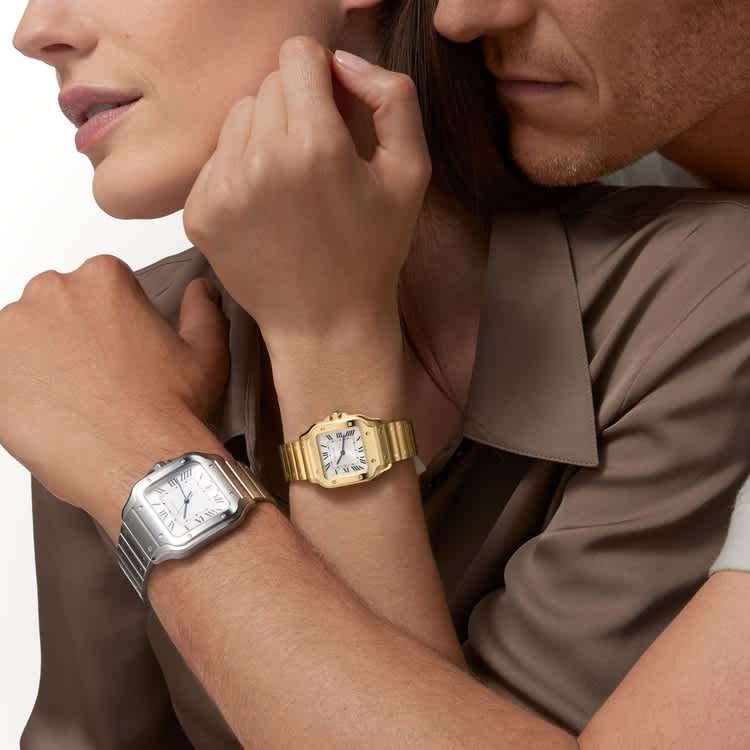
Modern Santos models (post-2018) maintain this exposed-screw philosophy while adding refined proportions. The 2018 redesign softened the formerly angular case geometry, integrated more flowing lugs, and created a visual relationship between bezel and bracelet that feels more unified than previous generations.
Tank: Refined Restraint
The Tank whispers where the Santos shouts. Its rectangular silhouette doesn’t announce itself through visual complexity; instead, it achieves elegance through perfect proportions—a layout so precisely balanced that any modification would feel jarring.
The Tank’s design philosophy prioritizes proportion over function, refinement over visibility. Dial features serve visual harmony rather than practical necessity—Roman numerals add classical reference, the minute track (chemin de fer) provides visual rhythm without disrupting the dial’s calm elegance.
This restraint explains why the Tank reads as inherently “dressier” than the Santos. Square watches (Santos) feel more muscular; rectangular watches (Tank) feel more elongated and refined. The Tank’s thinness relative to its width creates visual delicacy that the Santos’s more balanced proportions don’t convey.
Modern Features: Santos Innovations vs. Tank Tradition
The Santos: SmartLink and QuickSwitch Revolution
Cartier revolutionized bracelet functionality by introducing the SmartLink system (tool-free link adjustment) and QuickSwitch system (tool-free strap/bracelet interchangeability) on the 2018 redesign.
- Small button on each bracelet link when pressed releases the connecting pin
- Individual links can be removed or added without tools
- The pin remains semi-connected to the link to prevent loss
- Perfect fit achieved in seconds
- Discreet button positioned between the case lugs
- Pressing releases the bracelet from the lugs
- Any QuickSwitch-compatible strap clicks into place
- Enables metal bracelet → leather → rubber transitions without dealer visits
These innovations fundamentally transformed the Santos from static formal piece to chameleonic daily wearer. You can switch between steel bracelet (professional), leather (business-casual), and rubber (weekend) in literally 10 seconds without tools.
The Tank: Timeless Design, Incremental Refinement
The Tank family evolved differently—not through systemic innovation but through careful proportional refinement and material options. The modern Tank presents multiple sub-collections addressing different contexts:
Tank Must (~$3,300–$5,900): Entry-level interpretation featuring quartz movement, 25.5mm case, accessible positioning for first-time Cartier buyers.
Tank Louis Cartier (~$8,000–$20,000): Elevated positioning with automatic movement, larger case, premium finishing, higher-quality dial execution.
Tank Française (~$3,900–$34,000): Mid-range collection bridging the Must’s accessibility and Louis’s premium positioning.
Tank Américaine (~$3,400–$63,000): Curved variant with slightly wider proportions, offering subtle differentiation.
Tank Cintrée (~$80,000+): Ultra-rare curved design, produced in extremely limited quantities.
The Tank’s evolution prioritizes heritage preservation over innovation. Each variant tweaks proportions or materials while maintaining fundamental design DNA—a conservative approach reflecting the Tank’s secure cultural positioning.
Sizing and Fit: Understanding Cartier’s Architecture
Santos: Medium vs. Large
Modern Santos comes in three main sizes: Small (for women/petite wrists), Medium, and Large, plus extra-large chronograph variants.
- Feels larger than specs suggest (wears like a 36–37mm round watch)
- Ideal for wrists under 7 inches circumference
- Elegant daily wearer; balances presence with refinement
- MSRP: ~$7,500 (steel)
- Substantial wrist presence; genuinely noticed
- Perfect for wrists 7–7.5+ inches
- Bold statement piece; less “everyday” energy
- MSRP: ~$8,200 (steel)
The square case geometry makes sizing non-intuitive—case width doesn’t directly translate to perceived size because of the square’s spatial architecture. Most reviewers note that the Medium Santos actually wears as if it measures 36–37mm in diameter, while the Large commands 39–40mm equivalent presence.
Tank: Must (Small), Français (Medium), Louis (Large)
Tank sizing operates differently—proportionally smaller overall due to rectangular geometry and thin case (7.4mm thickness).
Tank Must (~25.5mm):
- Genuinely small and refined
- Best for business formal contexts
- Quartz movement (precise, maintenance-free)
- MSRP: ~$3,300–$5,900
Tank Française (~28mm):
- Moderate sizing; middle ground positioning
- Works across professional to casual contexts
- Automatic movement available
- MSRP: ~$3,900–$34,000+
Tank Louis Cartier (~33mm+):
- Largest traditional Tank proportions
- Dress watch scale (meaningful presence without boldness)
- Premium finishing throughout
- MSRP: ~$8,000–$20,000+
Tank models measure more conservatively than Santos—a Tank at 33mm genuinely measures 33mm without perceptual scaling. This reflects the Tank’s positioning as a dress watch where restraint governs sizing.
Practical Lifestyle Consideration
Choose Santos If:
- Daily versatility matters: SmartLink/QuickSwitch systems enable instant aesthetic transitions
- Bold presence appeals to you: Square case with exposed screws announces confidence
- Business-casual dominates: Perfect balance between professional credibility and casual personality
- Active lifestyle: 100m water resistance + metal bracelet handle daily wear without hesitation
- You prefer bracelet-first styling: Metal bracelet is default; leather/rubber available as alternates
- Modern design innovation: Tech-forward strap systems represent cutting-edge watch engineering
Best for: Digital entrepreneurs, creative professionals, weekend adventurers, those balancing professional success with personal style expression.
Choose Tank If:
- Refined elegance prioritizes: Rectangular geometry and minimalist dial whisper rather than shout
- Dress watch tradition appeals: Leather strap is primary identity; metal bracelet is alternate
- Formal occasions dominate: Black-tie events, conservative business environments, refined occasions
- Timeless aesthetic matters: You want a watch that’s appreciated for proportional perfection, not technical features
- History and heritage: 1917 inspiration and refined tradition matter
- Jewelry-watch sensibility: You wear watches as refined accessories, not functional instruments
Best for: Conservative business leaders, formal occasion enthusiasts, minimalist aesthetics advocates, those prioritizing understatement over innovation.
Investment and Resale Value
Both Santos and Tank enjoy strong value retention due to Cartier’s heritage and design permanence:
Santos de Cartier:
- 100+ year historical significance
- Modern redesigns maintain collector interest
- Average value retention: 65–75% over 5 years
- Steel models more liquid than gold variants
Tank (All Variants):
- Over 100 years of continuous production
- Iconic status ensures demand
- Average value retention: 70–80% over 5 years
- Tank Louis and vintage Tank models show stronger appreciation
The Final Choice
The Santos and Tank represent two complete watch philosophies—one celebrating functional boldness, the other pursuing refined elegance. The Santos says, “I’m accomplished and unafraid to show it.” The Tank says, “My taste is refined enough that I need not announce it.”
Neither is objectively superior. The Santos works better as a contemporary daily wearer with technical sophistication. The Tank endures as a refined statement for formal occasions and conservative aesthetics.
The real question isn’t “Which is the better watch?” but rather: “Which reflects who you are?”
Choose the shape that matches your wrist, your wardrobe, and your personality. Both are genuinely excellent—just in profoundly different ways.