
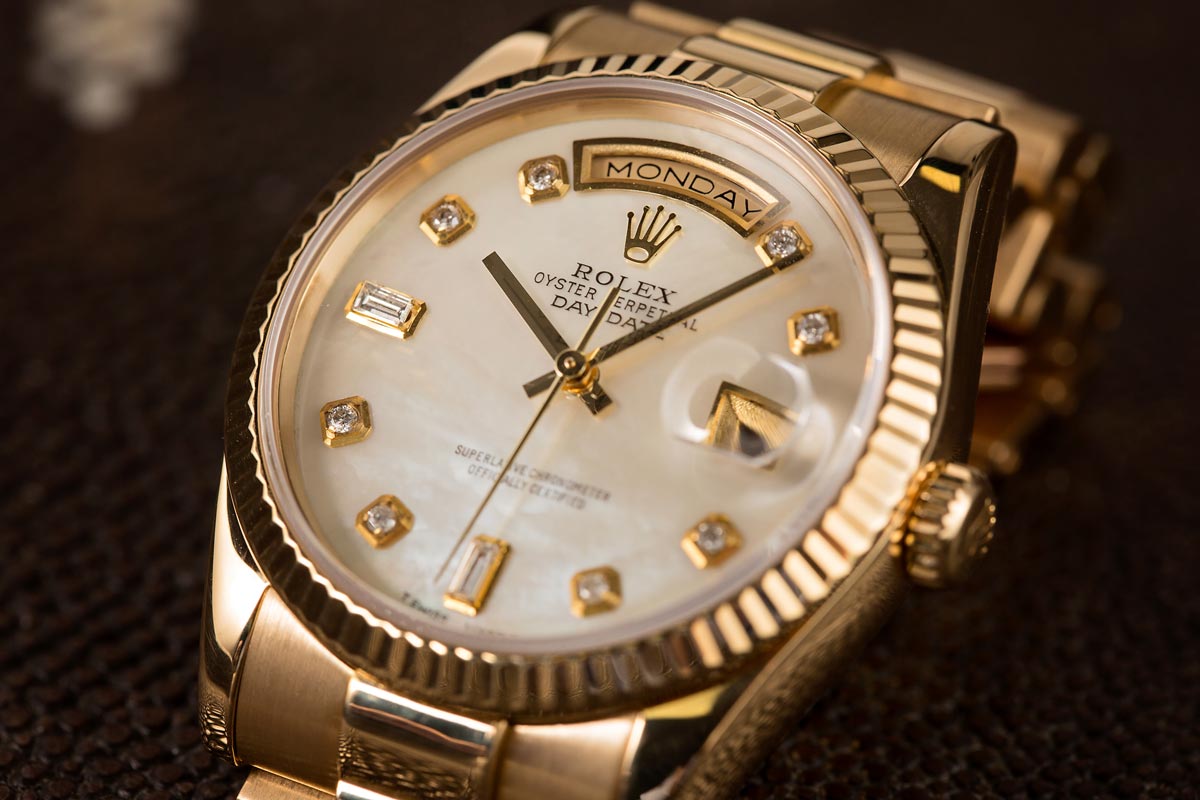
The Rolex Day-Date occupies a unique position in luxury horology—it’s simultaneously the watch that defines prestige itself and the watch that confuses newcomers most profoundly. At $31,350–$80,000+ MSRP (depending on material and dial configuration), the Day-Date costs nearly 5x more than a comparable Submariner despite featuring identical movement architecture and similar water resistance. This isn’t market irrationality or brand premium gone haywire. The Day-Date’s pricing reflects fundamental engineering differences, precious metal exclusivity, historical prestige, and complications that genuinely justify its position as Rolex’s ultimate luxury statement.
To understand why, you must first appreciate a single fact that separates the Day-Date from virtually every other modern Rolex: the Day-Date is never—under any circumstances—manufactured in stainless steel. This material exclusivity creates a philosophical and financial chasm between the Day-Date and everything else in the Rolex portfolio.
Precious Metals Only: The Foundation of Exclusivity
The Day-Date exists exclusively in gold or platinum. There is no stainless steel variant. There has never been a stainless steel variant. There will never be a stainless steel variant.
This isn’t marketing gimmick—it’s fundamental positioning. By restricting the Day-Date to precious metals, Rolex accomplishes several critical objectives simultaneously:
1. Creates genuine scarcity: Rolex produces fewer Day-Dates annually than Submariners because gold and platinum material costs impose production constraints that steel doesn’t face. Raw material supply for precious metals is inherently limited by mining economics.
2. Eliminates “affordable entry point” psychology: A $10k steel Rolex attracts financially aspirational buyers. A $31k gold Rolex attracts exclusively established wealth. The material constraint filters the audience to those genuinely capable of maintaining precious metal watches.
3. Establishes dress-watch positioning: Stainless steel suggests “sports watch durability”; precious metals whisper “luxury occasions only.” The Day-Date’s material choice signals explicit positioning as formal wear rather than gym-compatible tool.
4. Protects brand equity: Every steel Rolex purchased creates incremental brand familiarity and eventual used-market saturation. Precious metal watches remain exclusive through rarity and higher entry cost.
Current materials and pricing (November 2025):
- Yellow gold (18kt): $31,350–$41,000 MSRP (depending on bezel and dial)
- White gold (18kt): $32,500–$42,000 MSRP
- Rose gold (18kt Everose): $33,200–$42,500 MSRP
- Platinum (950): $45,000–$80,000+ MSRP (depending on dial and bezel treatment)
The platinum premium exceeds $12,000–$15,000 versus gold variants, reflecting platinum’s rarity and manufacturing complexity.
The President Bracelet: Engineering Refinement
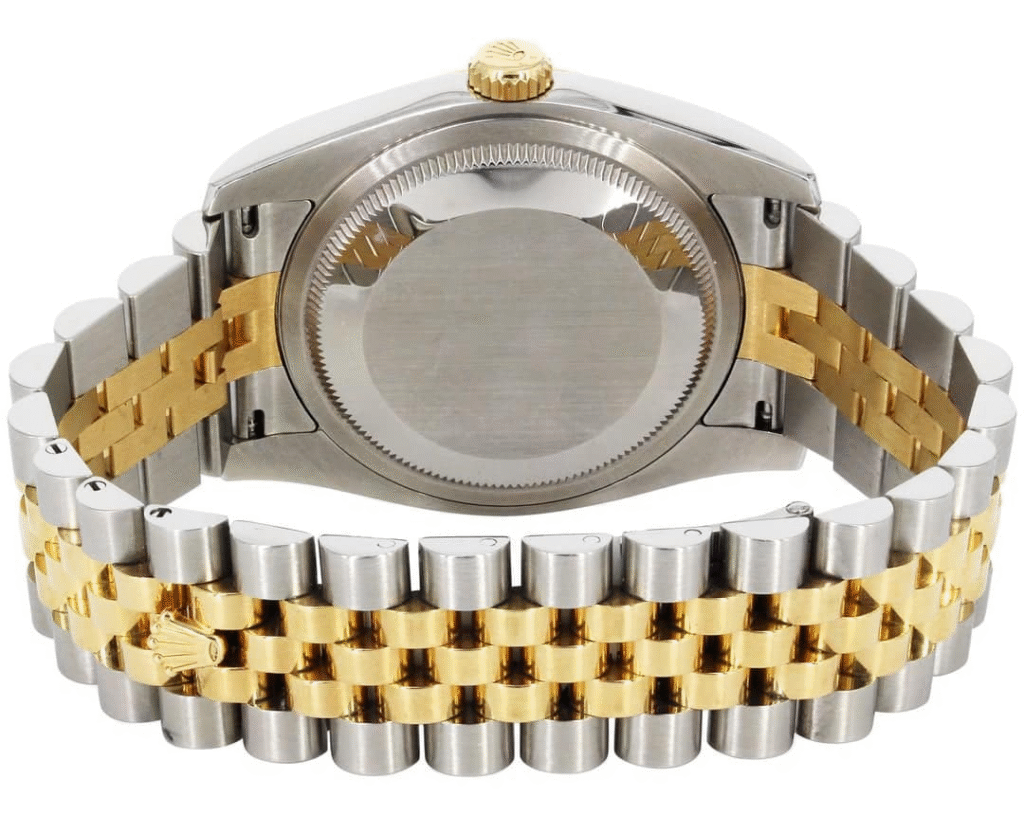
The President bracelet isn’t merely aesthetic—it represents one of Rolex’s most technologically sophisticated bracelet designs, exclusively manufactured in precious metals and exclusively available on the Day-Date (with rare exceptions on Lady-Datejust and other heritage models).
Three-Piece Semi-Circular Link Design
The President’s signature consists of semi-circular three-piece links arranged in elegant symmetry around the wrist. Unlike the Oyster bracelet’s angular three-link construction or the Jubilee’s delicate five-link weave, the President’s organic curves create visual continuity that feels almost sculptural.
- Center link: Polished precious metal forming the semi-circle
- Side links: Flanking polished pieces maintaining curved profile
- End links: Tapered connections to the case lugs, creating seamless integration
This three-piece architecture is deceptively complex—achieving proper tolerances across precious metal links requires extraordinary precision because slight misalignment becomes visually obvious when light reflects off polished surfaces.
The Concealed Crownclasp: Hidden Luxury
The President bracelet fastens exclusively via the Crownclasp—a concealed folding mechanism that remains nearly invisible when closed, allowing the bracelet’s curved links to wrap around the wrist without visual interruption from an obvious clasp mechanism.
Why this matters functionally:
- The Crownclasp’s two folding blades remain hidden beneath the bracelet links when closed
- No external latch bar interrupts the visual flow around the wrist
- The Crown logo appears subtly on the clasp lever when opened
- Proprietary security mechanism resists accidental opening while maintaining luxury aesthetics
This represents engineering philosophy contradiction—manufacturing extreme precision for a component designed to remain invisible. The Crownclasp requires tighter tolerances than visible clasps because any imperfection becomes obvious when you feel the mechanism engage.
The Caliber 3255: Movement Excellence
The Caliber 3255 represents Rolex’s evolutionary apex—a movement specifically engineered for the Day-Date’s dual date/day complications while achieving performance metrics that transcend traditional chronometer standards.
Raw Movement Specifications:
| Specification | Caliber 3255 | Industry Standard |
|---|---|---|
| Accuracy | -2/+2 seconds/day | COSC: -4/+6 seconds |
| Power Reserve | 70 hours | Typical: 48 hours |
| Escapement | Chronergy (patented) | Swiss lever |
| Escapement Efficiency | 15% improvement | N/A |
| Hairspring | Parachrom Blue (paramagnetic) | Traditional steel |
| Shock Resistance | 10x better than traditional | Baseline |
| Components Redesigned | 90% (vs. previous generation) | N/A |
| Patents Integrated | 14 patents | N/A |
The Chronergy Escapement Innovation:
The Chronergy escapement represents half of the 70-hour power reserve improvement. By optimizing the traditional Swiss lever escapement geometry, Rolex engineers achieved 15% improved efficiency—meaning the movement transmits more energy to the oscillator while reducing waste.
This doesn’t sound revolutionary until you understand mechanical watch physics: the escapement wastes roughly 65% of available energy in a traditional movement. Rolex’s Chronergy optimization recovers approximately 10% of otherwise-wasted energy through geometric improvements to the escapement’s pallet fork angles and escape wheel tooth profiles.
The Parachrom Hairspring:
The blue Parachrom hairspring (composed of niobium-zirconium alloy) provides:
- Paramagnetic properties: Immunity to magnetic interference beyond values encountered in daily life
- Temperature stability: ±10% tolerance across -10°C to +60°C (significantly better than traditional steel)
- 10x shock resistance: The hairspring resists deformation from impacts
- Absence of oxidation: Paramagnetic materials don’t corrode
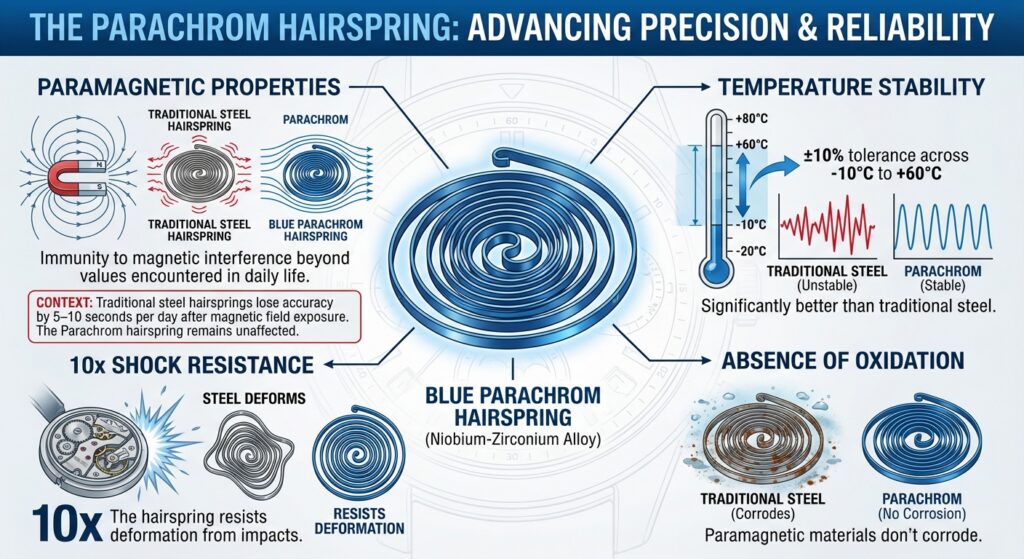
For context, traditional steel hairsprings lose accuracy by 5–10 seconds per day after magnetic field exposure. The Parachrom hairspring remains unaffected.
Variable Inertia Balance Wheel:
The balance wheel incorporates gold Microstella nuts that adjust inertia through micro-movements, allowing Rolex watchmakers to achieve unprecedented accuracy standards during assembly. This innovation enables -2/+2 second daily accuracy consistently—something traditional movements cannot achieve reliably.
Size Comparison: 36mm vs 40mm
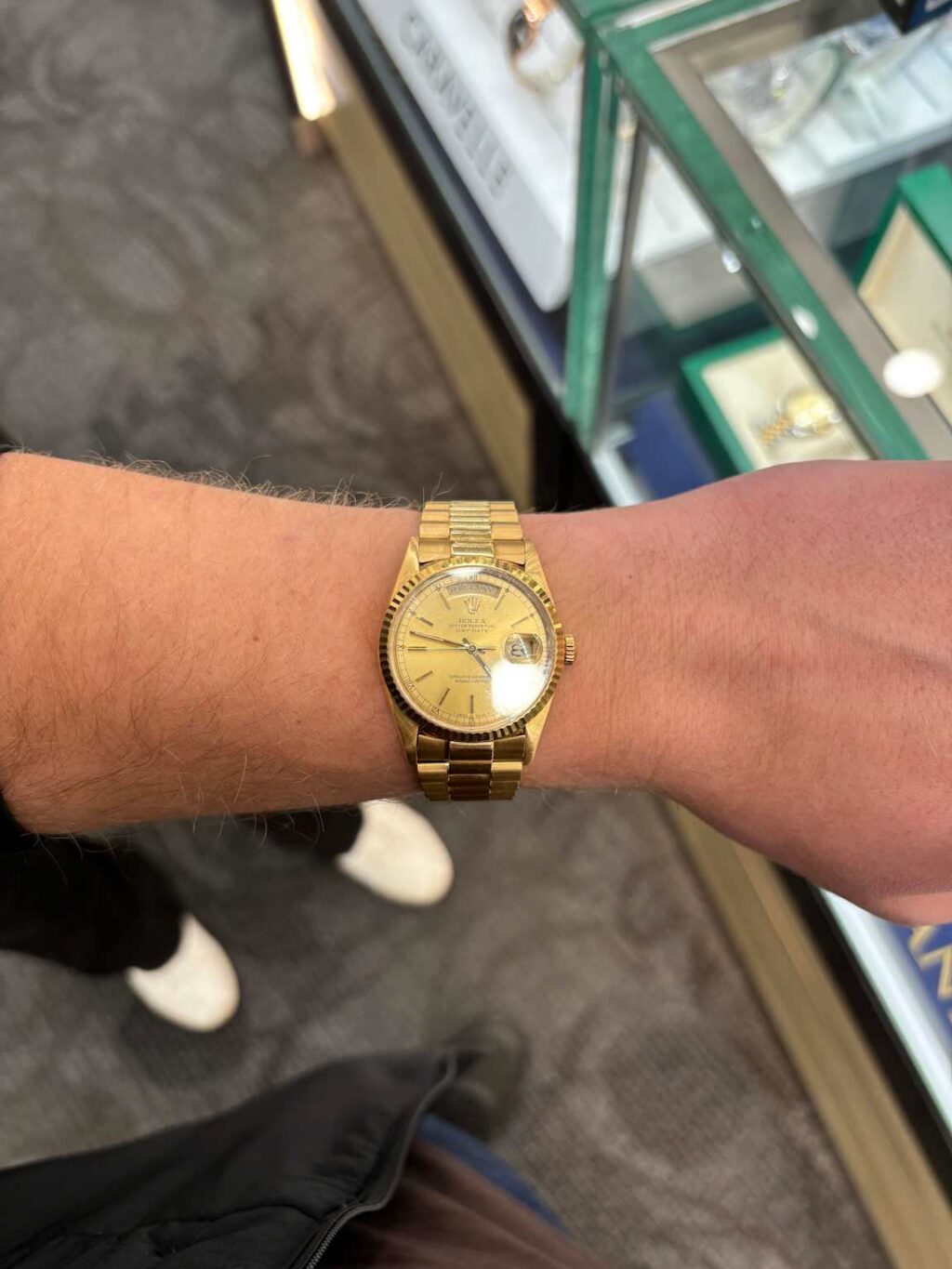
The Day-Date offers only two sizes: 36mm (the original and historically accurate choice) and 40mm (the modern contemporary option). This sizing philosophy mirrors the Datejust approach but with critical distinctions.
Dimensional Specifications:
| Specification | Day-Date 36 | Day-Date 40 |
|---|---|---|
| Case Diameter | 36mm (actual) | 40mm (actual) |
| Lug-to-Lug | 43.1mm | 45.4mm |
| Case Thickness | 11.8mm | 11.8mm |
| Weight (Gold) | 174 grams | 204 grams |
| Bracelet Width | 20mm | 21mm |
| Dial Diameter | ~30mm | ~32mm |
| MSRP (Yellow Gold) | $31,350 | $34,850 |
36mm: Classical Proportions
The 36mm Day-Date represents the original 1956 design—proportions established when presidents and world leaders routinely wore 36mm watches as formal wear. This sizing delivers several advantages:
Visual Density: At 174 grams of gold, the 36mm feels substantially heavier than its modest diameter suggests, creating presence without size-based bulk.
Cuff Compatibility: The 43.1mm lug-to-lug measurement allows effortless accommodation under formal dress shirt cuffs—an essential feature for watches worn at diplomatic events and board meetings.
Refined Aesthetics: The 36mm’s proportions evoke timeless luxury rather than contemporary “bigger is better” watch trends.
Ideal for wrists under 6.75 inches circumference, where the 36mm sits flush without lug overhang.
40mm: Contemporary Presence
Introduced in 2015 (replacing the discontinued 41mm Day-Date II), the 40mm Day-Date delivers modern sports-watch proportions while maintaining Presidential elegance:
Bold Wrist Presence: The 45.4mm lug-to-lug measurement creates obvious visual impact—the watch occupies meaningful space on the wrist.
Enhanced Dial Visibility: Larger hour markers and date/day apertures improve legibility versus the 36mm.
Thicker Lugs: The 40mm features more substantial lug construction, creating visual robustness that appeals to contemporary aesthetics.
Modern Proportions: The 40mm aligns with contemporary watch sizing preferences (most modern sports watches exceed 38mm).
Ideal for wrists exceeding 7 inches circumference or those preferring commanding presence.
The 30-Gram Weight Difference:
Many collectors overlook the practical significance: the 30-gram differential (174g vs. 204g) creates tangible comfort differences during all-day wear. Extended formal wear of the 40mm occasionally causes mild neck fatigue on petite frames, while the 36mm feels substantially lighter despite similar thickness.
Dial Mastery: The “Eisenkiesel,” Platinum Ice-Blue, and Onyx
The Day-Date’s dial options represent some of Rolex’s finest lacquer and finishing work—each configuration commanding distinct premiums and collector desirability.
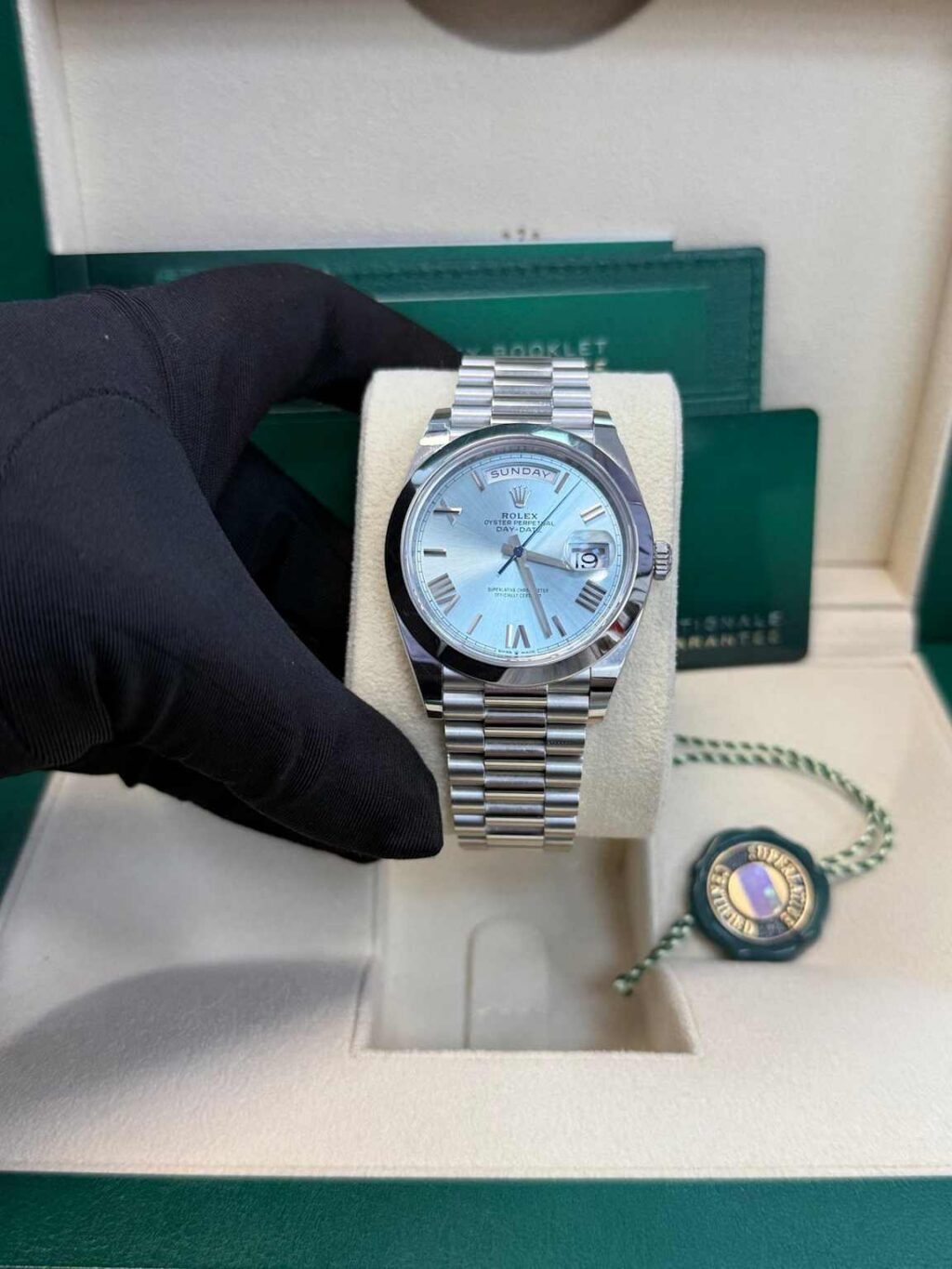
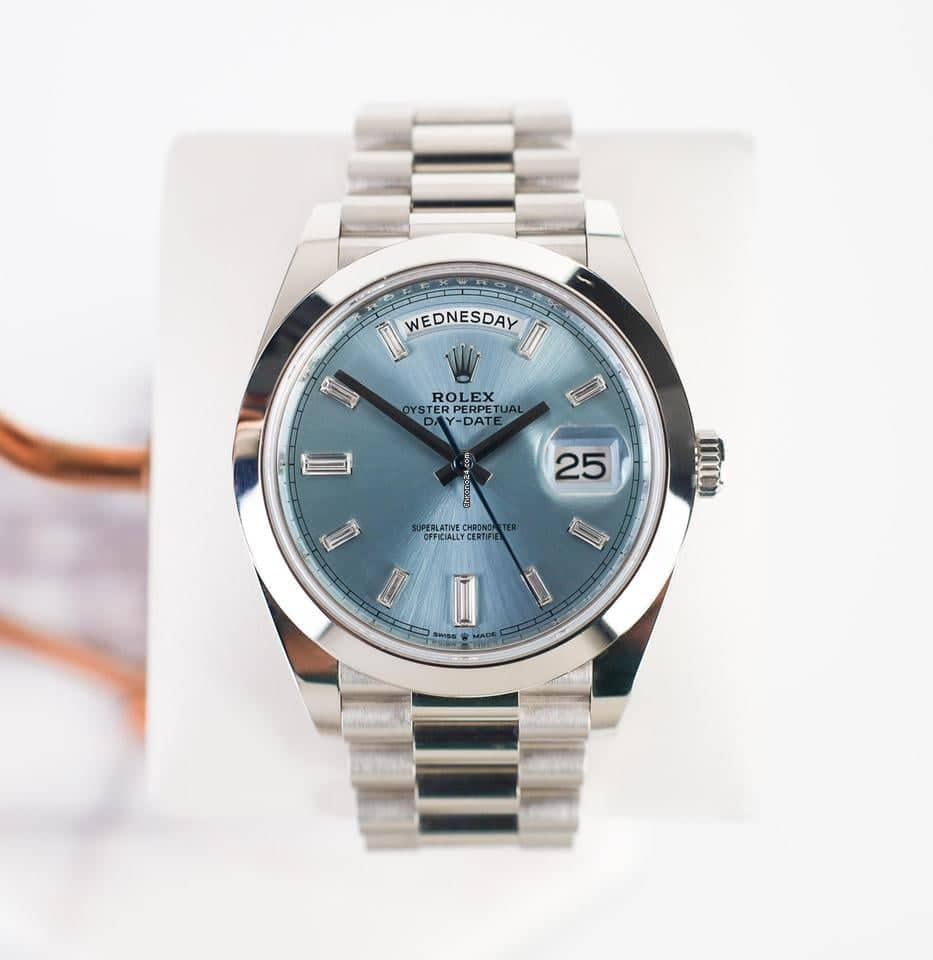
Ice-Blue Dial (Platinum Models Only)
Rolex reserves the exclusive ice-blue dial exclusively for platinum watches—a philosophical decision stating that only the noblest metals deserve the most sophisticated dial color.
This isn’t arbitrary: ice-blue requires specific platinum-case oxidation properties to achieve its ethereal luminescence. The precise micro-texture of platinum surfaces reflects light in ways gold cannot replicate.
- Available on Day-Date 36 and Day-Date 40 platinum models exclusively
- Sunburst finish creating depth and movement in light
- Often paired with diamond indices and baguette-cut diamond bezels
- Creates ethereal appearance impossible to photograph accurately
- Commands $5,000–$8,000 premiums over standard platinum dials
Onyx Dial
The onyx dial (appearing primarily on white gold models) features deep black lacquer with subtle surface texture, creating sophisticated formal aesthetics suitable for black-tie occasions.
Onyx dials require multiple spray coats and precise kiln temperatures—any deviation creates color inconsistency. Rolex’s quality control rejects approximately 15–20% of onyx dials during manufacture.
“Eisenkiesel” Dial
The “Eisenkiesel” (German for “iron gravel”) dial features distinctive granite-like texture created through specialized lacquer formulation incorporating micro-metallic particles. This dial appears primarily on white gold models and creates visual interest through light reflection off embedded particles.
Eisenkiesel dials represent Rolex’s most challenging dial manufacturing process—the micro-particle suspension must remain uniform throughout multi-stage spray application, and firing temperatures must remain precisely controlled to prevent particle migration or color variation.
The Reference Number Evolution: 228238, 228239, 228345
Modern Day-Date models use six-digit reference numbers reflecting their post-2000s introduction or update. Key models include:
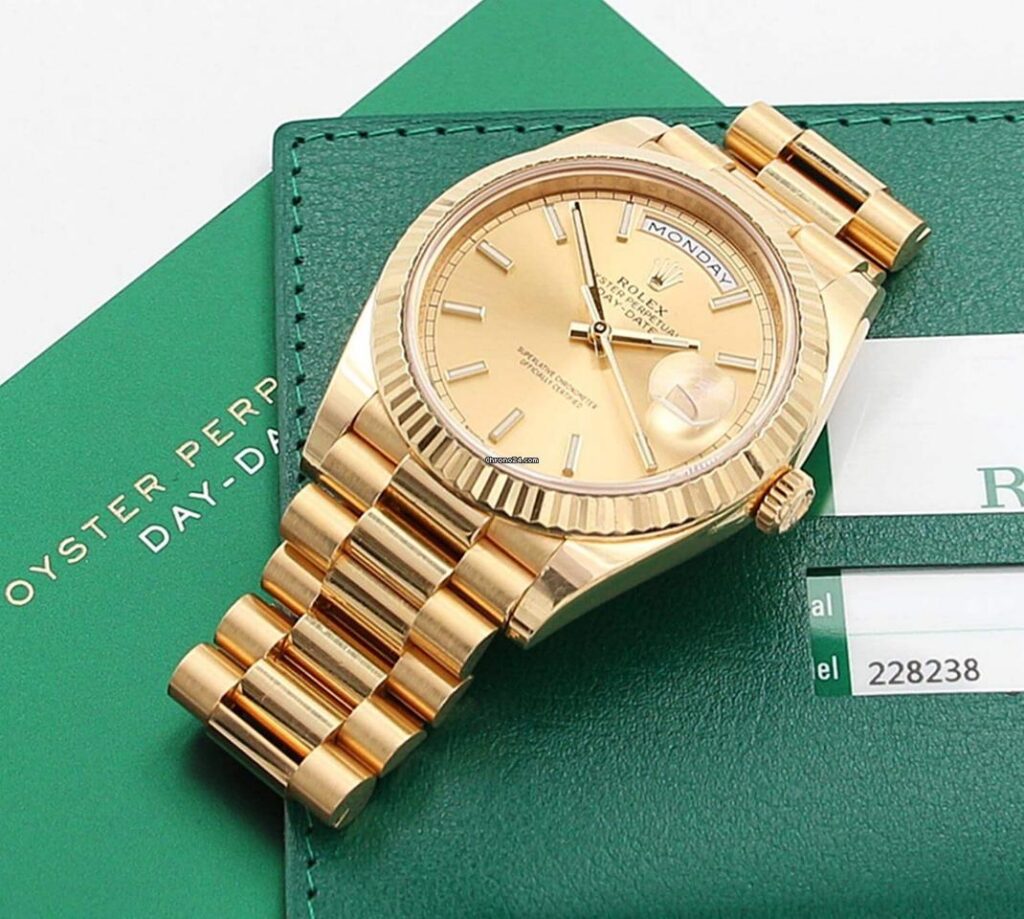
Ref. 228238 (Day-Date 40, Yellow Gold):
- 40mm 18k yellow gold case
- Caliber 3255 movement (70-hour power reserve)
- Available with fluted or smooth bezel
- Dial options: champagne, silver, black, chocolate, olive green
- MSRP: $34,850
- Grey market: $38,000–$45,000
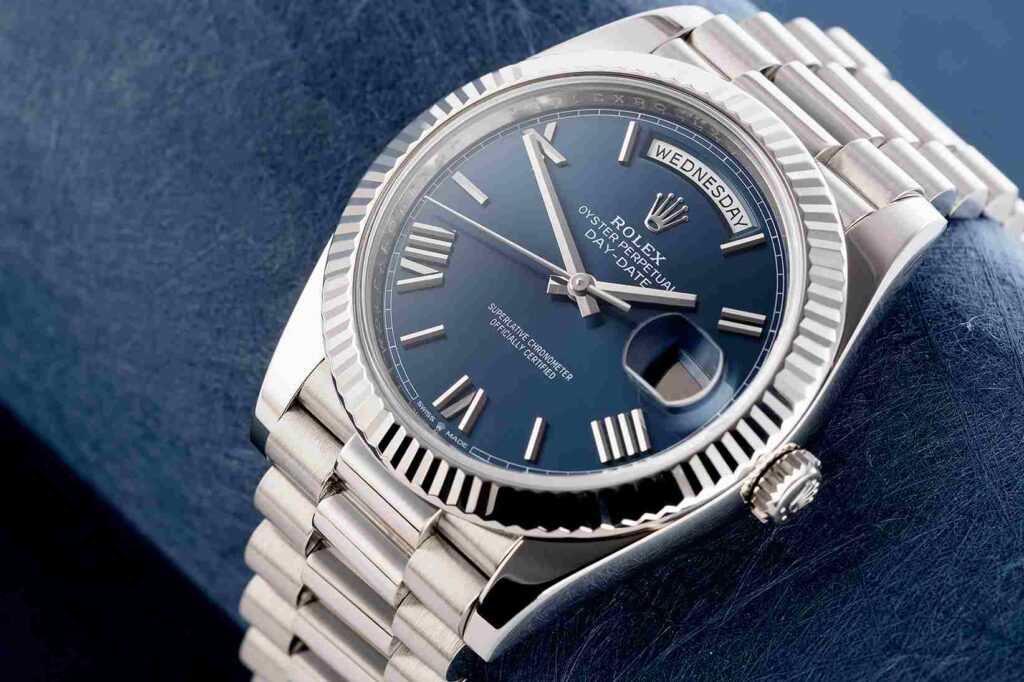
Ref. 228239 (Day-Date 40, White Gold):
- 40mm 18k white gold case
- Caliber 3255 movement
- Fluted bezel standard
- Dial options: silver, black, anthracite, olive green, ice blue
- MSRP: $35,850
- Grey market: $39,500–$47,000
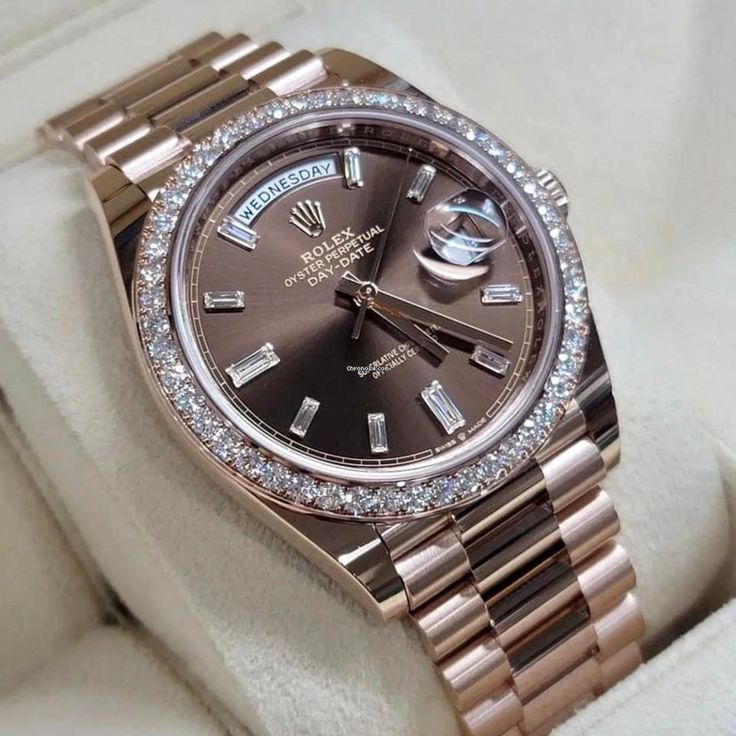
Ref. 228345RBR (Day-Date 36, Rose Gold – Premium):
- 36mm Everose gold case
- Mother-of-pearl dial with diamond hour markers
- Diamond-set bezel
- Caliber 3255 movement
- MSRP: $83,200+
- Grey market: $92,000–$125,000
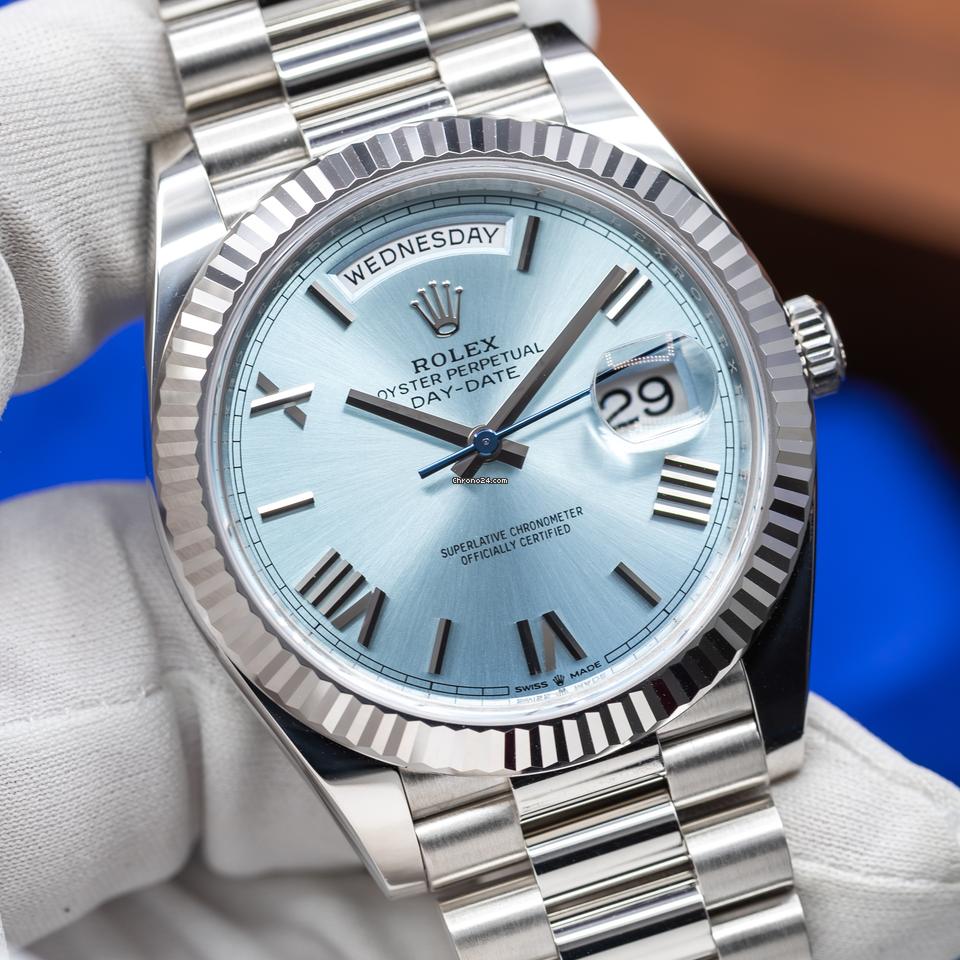
Ref. 128236 (Day-Date 36, Platinum – Ice Blue):
- 36mm platinum case
- Exclusive ice-blue dial (platinum only)
- Diamond indices
- Fluted bezel
- Caliber 3255 movement
- MSRP: $65,000+
- Grey market: $72,000–$95,000
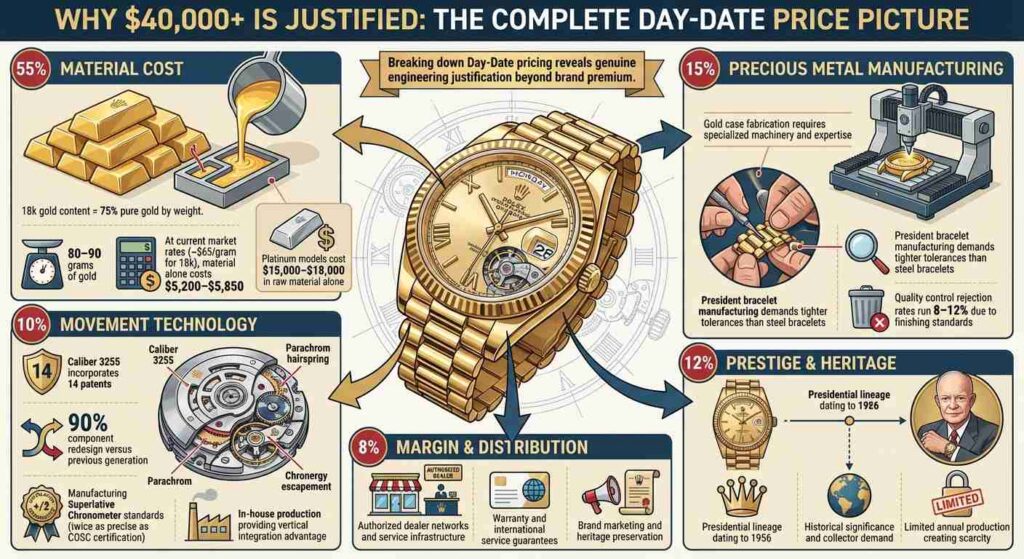
Why $40,000+ is Justified: The Complete Picture
Breaking down Day-Date pricing reveals genuine engineering justification beyond brand premium:
Material Cost (55% of price):
- 18k gold content = 75% pure gold by weight
- A 40mm Day-Date contains approximately 80–90 grams of gold
- At current market rates (~$65/gram for 18k), material alone costs $5,200–$5,850
- Platinum models cost $15,000–$18,000 in raw material alone
Precious Metal Manufacturing (15% of price):
- Gold case fabrication requires specialized machinery and expertise
- President bracelet manufacturing demands tighter tolerances than steel bracelets
- Quality control rejection rates run 8–12% due to finishing standards
Movement Technology (10% of price):
- Caliber 3255 incorporates 14 patents
- 90% component redesign versus previous generation
- Manufacturing Superlative Chronometer standards (twice as precise as COSC certification)
- In-house production providing vertical integration advantage
Prestige & Heritage (12% of price):
- Presidential lineage dating to 1956
- Historical significance and collector demand
- Limited annual production creating scarcity
Margin & Distribution (8% of price):
- Authorized dealer networks and service infrastructure
- Warranty and international service guarantees
- Brand marketing and heritage preservation
The Investment Case
Day-Date watches have appreciated approximately 180–250% over 10 years (2015–2025), with platinum models and specialized dials (ice-blue, diamond-set) appreciating faster than standard configurations.
Unlike steel Rolex sports watches (Submariner, GMT-Master II) experiencing pandemic-era speculation bubbles, Day-Date appreciation remains relatively stable and grounded in precious metal content and genuine collector demand—not speculative fervor.
Conclusion: Why Presidents Wear Presidents
The Rolex Day-Date commands its $31,000–$80,000+ price point through a combination of precious material exclusivity, elite movement engineering, manufacturing precision exceeding industry standards, and historical positioning as the world’s ultimate luxury watch.
It’s not that the Day-Date is better than a steel Submariner at telling time—mechanical movement accuracy differences prove negligible in real-world wear. Rather, the Day-Date represents an entirely different category: a precious metal luxury instrument designed exclusively for formal wear and refined occasions, manufactured with material and technical specifications that genuinely justify premium positioning.
For those questioning whether $40,000 for a watch is rational: the Day-Date isn’t marketed toward rationality. It’s marketed toward accomplishment, prestige, and the philosophical conviction that certain occasions demand the finest luxury instrument available.
That it happens to tell time excellently is almost secondary.