
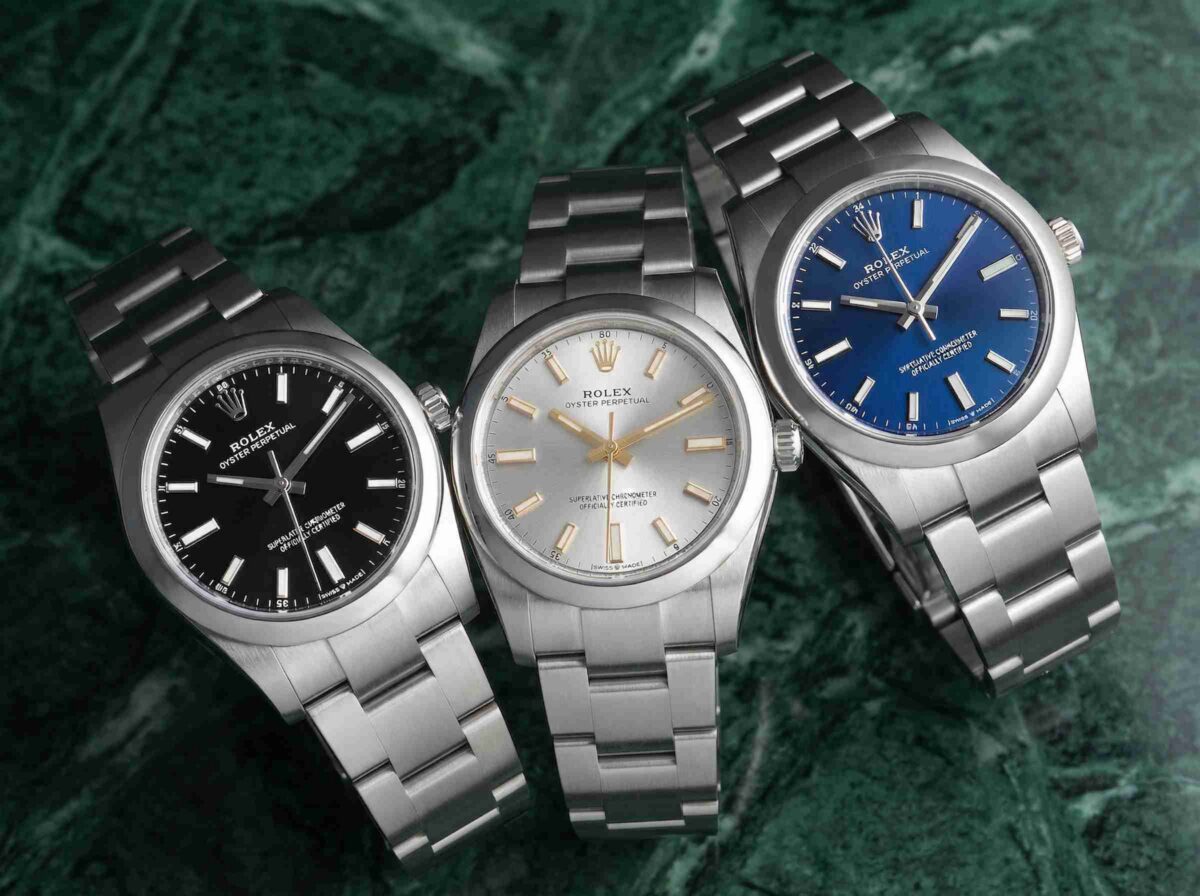
The Rolex Oyster Perpetual represents one of horology’s greatest paradoxes—a watch designed as the brand’s most accessible timepiece has become one of the hardest to buy at retail and one of the most absurdly overpriced on secondary markets. Priced at approximately $6,500–$6,800 MSRP, entry-level Oyster Perpetuals routinely sell for $12,000–$20,000+ on the grey market, particularly in the coveted Tiffany turquoise or Celebration multicolor variants. This isn’t just inflation or supply shortage—it’s a manufactured hype bubble built on Instagram aesthetics, social media visibility, and the fundamental truth that Rolex’s brand power transcends rational pricing.
Yet here’s what makes this phenomenon genuinely interesting: the Oyster Perpetual is actually an exceptional watch objectively. It’s not the hype that’s irrational—it’s the execution and positioning that’s transcended its modest entry-level positioning.
The Philosophy: Pure Rolex, Stripped Bare
When Hans Wilsdorf created the first Oyster Perpetual in 1926, he established a watchmaking principle that defined the brand for a century: eliminate everything unnecessary, perfect everything that remains. The modern Oyster Perpetual adheres to this philosophy with religious fervor—there is no date window, no fluted bezel, no complications, no crown guards, no precious metal options, no chronograph subdials.
What remains is almost monastic in its simplicity: a smooth stainless steel case, an Oystersteel bracelet, a dial featuring only hour markers or numerals, and the Caliber 3230 movement—the same superior automatic engine found in Submariner no-date variants.
This radical minimalism is precisely why the modern Oyster Perpetual confuses buyers. In a brand portfolio dominated by tool watches (Submariner), pilot watches (GMT-Master II), and complications (Sky-Dweller), the OP exists as a defiant rejection of watchmaking excess. It argues, somewhat polemically, that a timepiece need not justify itself through function beyond accurate time display.
And yet, most buyers never appreciate this philosophy—they covet the Oyster Perpetual because certain dial colors have become status symbols and Instagram darlings.
Understanding the Size Range: From 28mm to 41mm
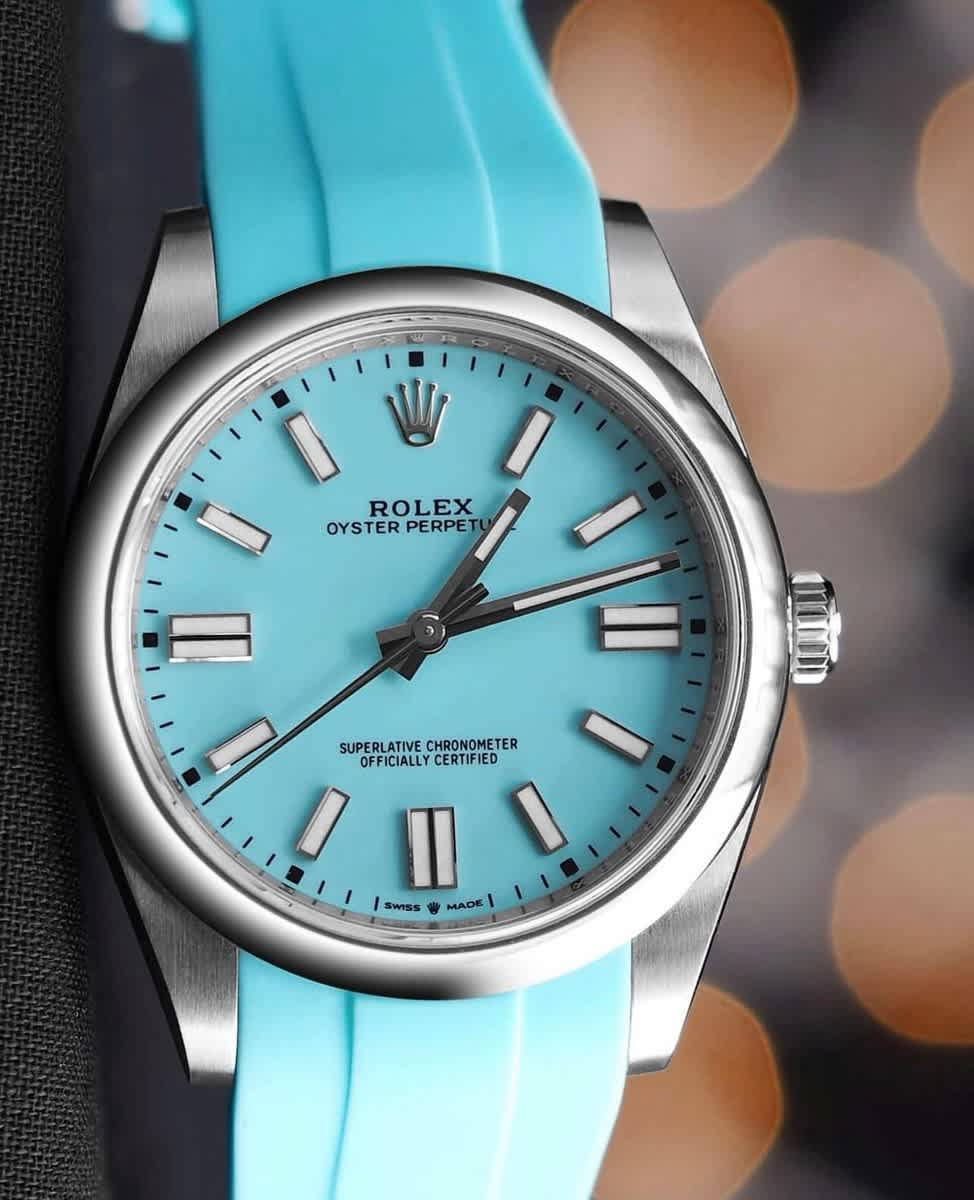
The Oyster Perpetual lineup spans five sizes: 28mm, 31mm, 34mm, 36mm, and 41mm—offering proportions for virtually every wrist type and aesthetic preference.
28mm serves women and those favoring extremely conservative proportions. At 33.4mm lug-to-lug, this diminutive reference demands slim wrists or purely dress-watch contexts.
31mm bridges the gap between true women’s sizing and unisex proportions. Some men with petite wrists find this size appropriate for dress occasions.
34mm occupies a nostalgic middle ground—historically the “men’s size” in pre-1970s Rolex terms. Modern collectors appreciate the 34mm for vintage aesthetics on contemporary movements, though it reads as significantly smaller than contemporary expectations.
36mm represents the new unisex gold standard. With 43.1mm lug-to-lug measurements, the 36mm OP works beautifully on wrists from 6.0–7.5 inches and transitions seamlessly from casual to formal contexts. The 36mm feels substantial enough to command presence without overwhelming delicate wrists.
41mm delivers contemporary sports-watch presence at 47.4mm lug-to-lug. Marketed as “41mm,” actual case diameter measures closer to 39.5mm, making it slightly more approachable than its nomenclature suggests. The 41mm dominates larger wrists (7+ inches) and delivers greater dial visibility and presence.
The 2020 “Stella” Dial Revolution: When Colors Became Commodities
In 2020, Rolex made a decision that fundamentally transformed the Oyster Perpetual from practical tool to collector’s item: introducing vibrant lacquered dials inspired by vintage 1970s “Stella” aesthetics.
The initial lineup featured four colors: turquoise (soon called “Tiffany”), coral red, yellow, and green—each applied using specialized spray-painting techniques and multi-layer lacquer formulations. These weren’t simple dial colorations; they represented technical achievements requiring extraordinary precision to achieve the mirror-like jewel-tone finishes.
The Turquoise Explosion
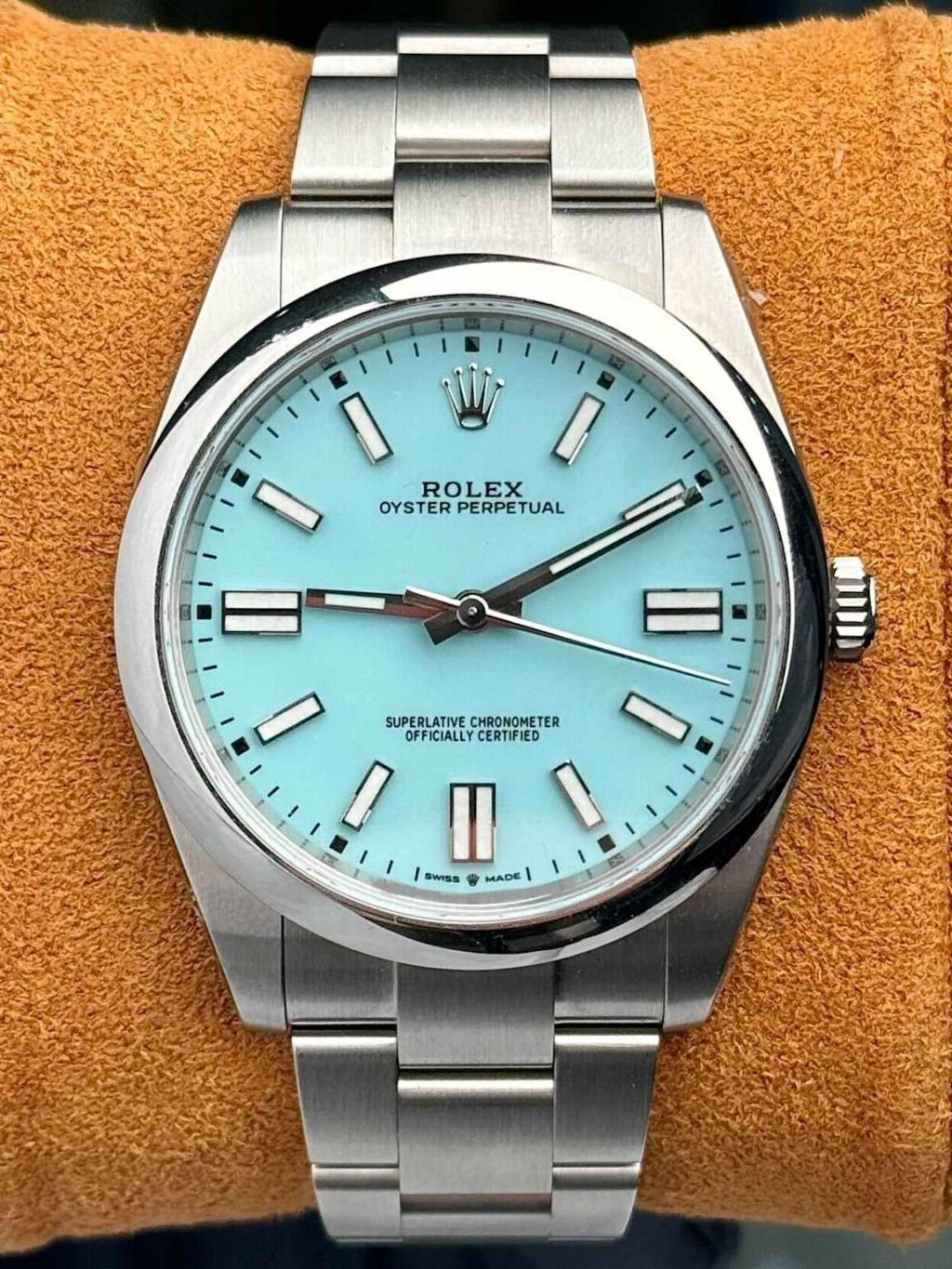
The turquoise dial immediately became a phenomenon. When Patek Philippe’s Tiffany & Co. Nautilus 5711 sold for $6.5 million at Phillips auction in December 2021, turquoise-dial watches became the watch world’s holy grail. The Rolex OP Turquoise—at roughly one-thousandth the Patek’s price—suddenly represented the “accessible turquoise luxury watch.”
By 2022–2023, Oyster Perpetual Turquoise dials had reached insane secondary market premiums:
- 41mm Turquoise: $18,000–$25,000 (vs. $6,800 MSRP = 165–268% premium)
- 36mm Turquoise: $16,000–$22,000 (vs. $6,500 MSRP = 146–238% premium)
Why These Premiums Exist
1. Scarcity: Rolex produces far fewer colored variants than black/silver dials, creating genuine supply constraints that manufacturing simply cannot resolve.
2. Social media visibility: When celebrities (LeBron James, Roger Federer, etc.) wear turquoise OPs, Instagram amplifies demand exponentially.
3. Perception of “temporary” availability: Collectors feared these colors would disappear, creating FOMO-driven buying behavior.
4. Daylight visibility: Turquoise and coral red catch light dramatically compared to traditional dial colors, making them visually distinctive.
The uncomfortable truth: Buyers increasingly pay these premiums not for horological merit but for the crown on the dial and the specific color’s Instagram aesthetic. This represents a fundamental shift—the Oyster Perpetual transitioned from “pure watch” to “luxury status symbol.”
The 2023 “Celebration” Dial: Hype, Polarization, and Collectibility
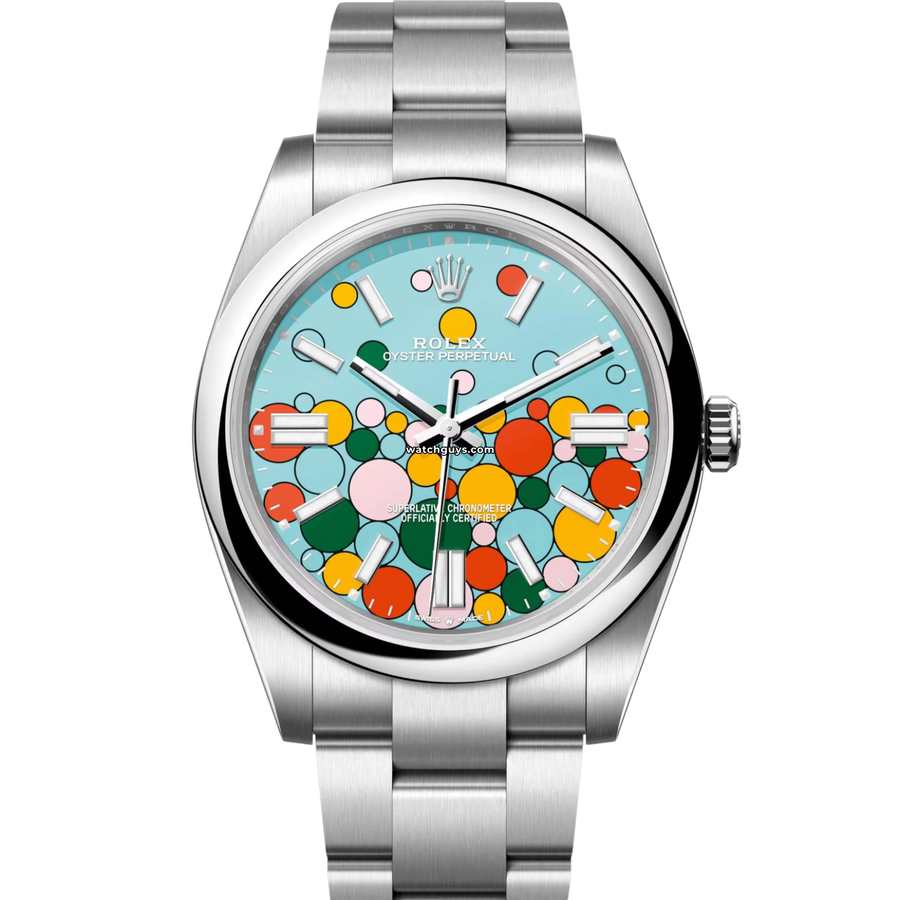
In March 2023, Rolex introduced what became its most divisive release: the “Celebration” dial (reference 124300-0008), featuring approximately 51 multicolored bubbles scattered across a turquoise base, incorporating all five original Stella colors—pink, turquoise, yellow, red, and green.
Reactions split dramatically:
Detractors compared it to a McDonald’s ball pit, a children’s coloring book, and a jar of jawbreakers—arguing it violated Rolex’s restrained design DNA.
Supporters praised its playful irreverence—a watch that doesn’t take itself seriously from a brand synonymous with serious tool watches. Some speculated it represented Rolex’s tongue-in-cheek commentary on its own asset-bubble status during pandemic-era speculation.
Celebrity adoption cemented its collectibility. Tom Holland, Lionel Messi, Kendrick Lamar, and Tom Brady wore Celebration dials publicly, transforming a “design experiment” into a luxury commodity.
By 2024, Rolex had discontinued the Celebration dial, making existing examples increasingly scarce. Secondary market pricing reflects this status:
- 41mm Celebration dial: $18,000–$22,000 (vs. $7,550 launch MSRP = 138–191% premium)
- 36mm Celebration dial: $16,500–$20,000 (vs. $7,150 launch MSRP = 130–180% premium)
Movement & Technical Excellence: Caliber 3230
The 36mm and 41mm Oyster Perpetuals house the Caliber 3230, Rolex’s cutting-edge time-only movement—the same engine used in no-date Submariner models.
Specifications that justify premium positioning:
| Feature | Specification |
|---|---|
| Power Reserve | 70 hours (exceptional for mechanical watches) |
| Accuracy | -2/+2 seconds per day (COSC + Rolex Superlative certification) |
| Escapement | Chronergy (patented, 15% more efficient than standard Swiss lever) |
| Hairspring | Parachrom Blue (paramagnetic, 10x shock-resistant) |
| Shock Resistance | Paraflex absorbers |
| Water Resistance | 100 meters (adequate for daily wear) |
| Frequency | 28,800 bph (4 Hz) |
The uncomfortable truth: The Caliber 3230 is genuinely exceptional—providing movement-level specifications that rival watches costing $15,000+. For horological merit alone, the Oyster Perpetual justifies its $6,800 MSRP completely.
The secondary market premiums, however? Those exist purely because of dial colors and hype, not movement quality.
Market Value Analysis: Why $6,800 Becomes $16,000
Understanding the absurd secondary market pricing requires acknowledging multiple factors operating simultaneously:
Supply-Demand Mismatch (70% of premium):
Rolex produces approximately 50,000 Oyster Perpetuals annually across all sizes. Current demand estimates suggest 2–3x the production volume. This supply constraint alone justifies 10–20% premiums.
Colored Dial Scarcity (15% of premium):
Within the 50,000 annual OPs, Rolex allocates only 10–15% to colored variants. Standard black/silver dials dominate production, making turquoise and coral red represent perhaps 2–3% of annual volume.
Brand Desirability (10% of premium):
Rolex occupies a unique position—owning a Rolex signals achievement independent of watch comprehension. Non-watch enthusiasts recognize the crown logo.
Social Media Amplification (5% of premium):
Celebrity visibility, Instagram aesthetics, and influencer endorsements create FOMO-driven demand among fashion-conscious buyers with disposable income.
The verdict: The secondary market is now driven by collectors who understand watches (20–30% of buyers) and aspirational buyers seeking brand status (70–80% of buyers). This demographic shift explains the OP’s paradoxical positioning—simultaneously the “entry-level” Rolex and one of the least accessible at retail prices.
Value Proposition: Bad Investment, Excellent Watch
Here’s the critical distinction: the Oyster Perpetual is an excellent watch at terrible value.
Why it’s excellent:
- Caliber 3230 movement delivers Superlative Chronometer precision
- 904L Oystersteel construction resists corrosion indefinitely
- Dial simplicity achieves timeless elegance
- 70-hour power reserve eliminates daily winding frustration
- Fits virtually any wrist size (five options available)
- Comfortable Oyster bracelet with Easylink extension system
- Tool-watch durability without tool-watch complications
Why the pricing is terrible:
- $6,800 MSRP for a time-only steel watch with zero complications is already aggressive
- Secondary market markups of 150–250% exist purely for colored dials and hype, not horological advancement
- Significant alternatives exist under $5,000 (Grand Seiko Spring Drive models, Tudor Black Bays, Omega Seamasters) offering superior finishing and equivalent or better movement technology
- You’re essentially paying $12,000–$18,000 for the Rolex crown on the dial, not for anything watch-specific
The Honest Recommendation
Buy an Oyster Perpetual if:
- You appreciate mechanical purity and intentional minimalism
- You value 70-hour power reserve and COSC certification
- You prefer simplicity over complications
- You’re willing to access retail pricing through authorized dealers (patience required: 2–4 year waitlists)
- You genuinely love the specific dial color (not buying for investment)
Don’t buy an Oyster Perpetual if:
- You’re paying secondary market prices (anything above $10,000)
- You’re hoping for investment appreciation (watch price stability is best case scenario)
- You desire visible complications or date windows
- Budget is a constraint (superior watches exist in the $3,000–$5,000 range)
- You’re buying primarily for brand status rather than watch appreciation
Conclusion: The Most Honest Rolex
The Rolex Oyster Perpetual remains the brand’s most authentic expression—pure watchmaking stripped to essentials, uncompromised by complications or aesthetic excess. At retail pricing ($6,500–$6,800), it represents honest value for a Rolex with cutting-edge movement technology and exceptional durability.
The secondary market premiums, however, have transformed the OP from practical luxury into speculative commodity. When you’re paying $18,000 for a turquoise dial time-only watch, you’re not buying horological excellence—you’re buying Instagram aesthetics and brand prestige.
The real travesty? The Oyster Perpetual deserves respect as a watchmaking achievement, but instead it’s become a case study in how brand power and social media visibility can completely decouple a watch’s actual value from its perceived value.
For those who appreciate watches without needing external validation? The OP at retail remains genuinely special. For everyone else paying grey market prices? You might consider whether that particular crown on that particular dial is truly worth the premium they’re charging.